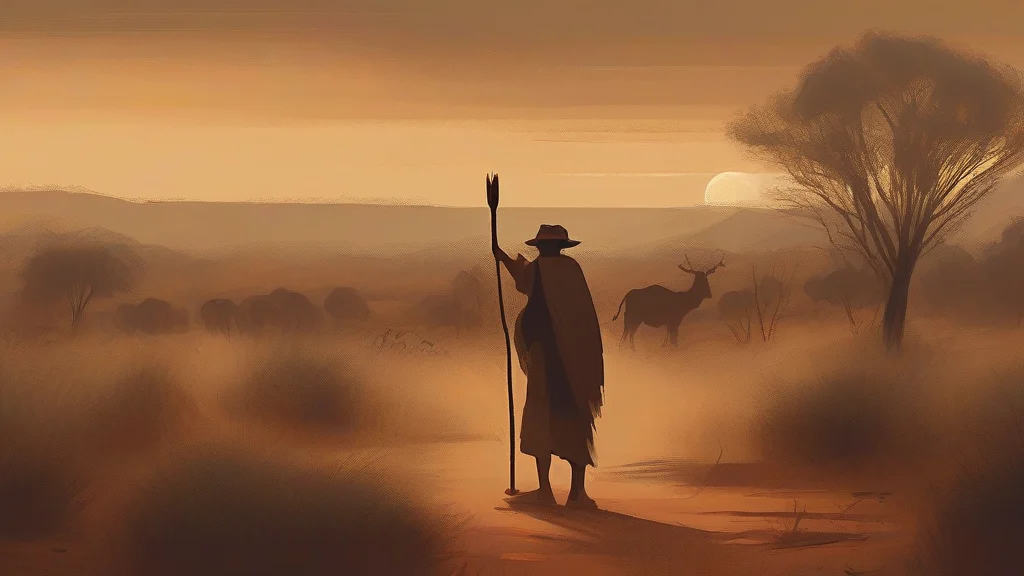
What does bushman mean?
A bushman is someone who lives, works, or travels with skill in wild, sparsely settled country — most characteristically the Australian outback or the African veldt. In Australia the word carries strong cultural weight: the bushman is a national archetype, evoking self-reliance, practical ingenuity, and a laconic toughness shaped by drought, distance, and isolation, celebrated in folklore and poetry from the nineteenth century onward. The word is simply formed: bush, the British-Australian term for uncleared wilderness, plus man. It appears in phrases like "an old bushman" or "bushman's hat," the latter so emblematic it features on Australia's coat of arms. In South African English the related term was historically applied to the San hunter-gatherer peoples, a usage now regarded as offensive and largely abandoned in favor of "San." For general readers today, bushman is best understood as a respectful, evocative label for a person genuinely at home in remote bushland rather than a casual hiker or camper.
nounA person who lives or works in the bush, especially the wild or sparsely settled countryside of Australia or southern Africa; in South African usage it has also been applied (often offensively) to the San people.
- A person who lives or travels expertly in wild or unsettled country, especially the Australian or African bush.
- (South Africa, dated and often offensive) A member of the San people of southern Africa.
"The old bushman guided them through the outback with an ease that came from fifty years of living off the land."
"An experienced bushman can read the land — where water lies hidden and which tracks lead home."
"Early colonial accounts describe the bushman as a solitary figure at home among gum trees and scrub."
The plural follows the standard irregular -man → -men pattern shared with words like "workmen" and "Englishmen."
"Bushmen of the region developed an intimate knowledge of seasonal waterholes."
The wide-brimmed 'bushman's hat' became so iconic to the Australian outback that it now appears on the national coat of arms.
Reviewed by Deb Chak, Editor. AI-assisted content curated by RJS Tech Solutions LLP.
Etymology of bushman
The word is a straightforward English compound of "bush," meaning wild or uncultivated land, and "man." It emerged in colonial English during the early nineteenth century, particularly in Australia and southern Africa, where settlers adopted "bush" for the uncleared wilderness surrounding their settlements. The root "bush" itself traces back through Middle English to Old English "bysc," cognate with Dutch "bos" and German "Busch." Related forms include "bushy," describing thick vegetation, and the rarer literary words "bosky" and "boscage," both borrowed via French and Latin from the same Germanic source.
Related word forms
How bushman is actually used
In Australian English the term carries a rugged, laconic, often affectionate connotation tied to national identity; elsewhere it is more neutral or descriptive. The capitalized "Bushmen" as a name for the San people is widely considered outdated and potentially offensive, so avoid that sense unless discussing the term itself.
Easily confused with bushman
"Bushmen" (capitalized) is a collective term for the San people of southern Africa, whereas "a bushman" generally means any person skilled at living in remote bush country.