
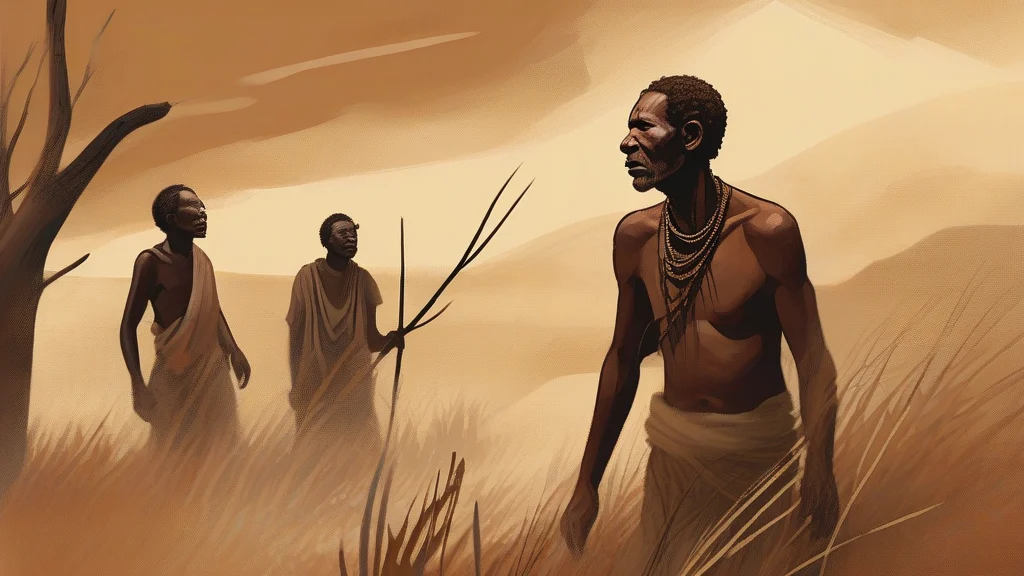
What does bushmen mean?
Bushmen is the plural form of bushman, a noun describing a man who lives in, works in, or expertly navigates wild, sparsely settled bush country. The term arose in colonial-era Australia and southern Africa for drovers, hunters, and settlers adept at survival far from towns. It also has a distinct ethnographic meaning: the San peoples of the Kalahari, among the oldest continuous cultures on Earth, long referred to as Bushmen in older anthropological writing. Today that usage is fading because many consider it dated or colonial in tone, with 'San' preferred instead. The word evokes self-reliance, deep local knowledge, and life close to nature, making it useful both in historical writing about frontier life and in discussion of southern African indigenous heritage — provided the context and connotations are handled thoughtfully.
nounThe plural of bushman: a man who lives in or is skilled at surviving in wild, undeveloped bush country; also used to refer collectively to members of the San peoples of southern Africa.
- A man who lives, works, or travels skillfully in wild bush country, especially in Australia or South Africa.
- A member (or members) of the San peoples of southern Africa, traditionally hunter-gatherers of the Kalahari region.
"The Australian bushmen knew every waterhole and track across the vast outback."
"Generations of bushmen had carved stock routes through the trackless interior."
"Rock art attributed to the bushmen dates back thousands of years."
Already the standard plural of bushman; the singular is bushman.
"Several bushmen gathered at the homestead before the muster."
One word, two worlds: 'bushmen' can mean rugged outback survivors in Australia or one of humanity's oldest living cultures — the San of the Kalahari.
Reviewed by Deb Chak, Editor. AI-assisted content curated by RJS Tech Solutions LLP.
Etymology of bushmen
Bushman is a straightforward English compound of 'bush', meaning wild or uncleared country, and 'man'; it took hold during European colonization of southern Africa and Australia from roughly the late 18th century onward. In southern Africa it was applied by colonists to the San hunter-gatherers, while in Australia it came to denote anyone at home in remote outback terrain. Its cognates are simply other English compounds built on the same productive '-man' pattern, such as woodsman and frontiersman.
How bushmen is actually used
When applied to the San peoples of southern Africa, the term carries colonial-era connotations and is increasingly replaced by 'San' in respectful contemporary usage; it remains neutral when describing skilled bush travelers or rural workers in Australia and South Africa.
Easily confused with bushmen
Bushmen refers to indigenous San hunter-gatherers of southern Africa or men of the bush generally, whereas Boers were descendants of Dutch-speaking settlers in South Africa.