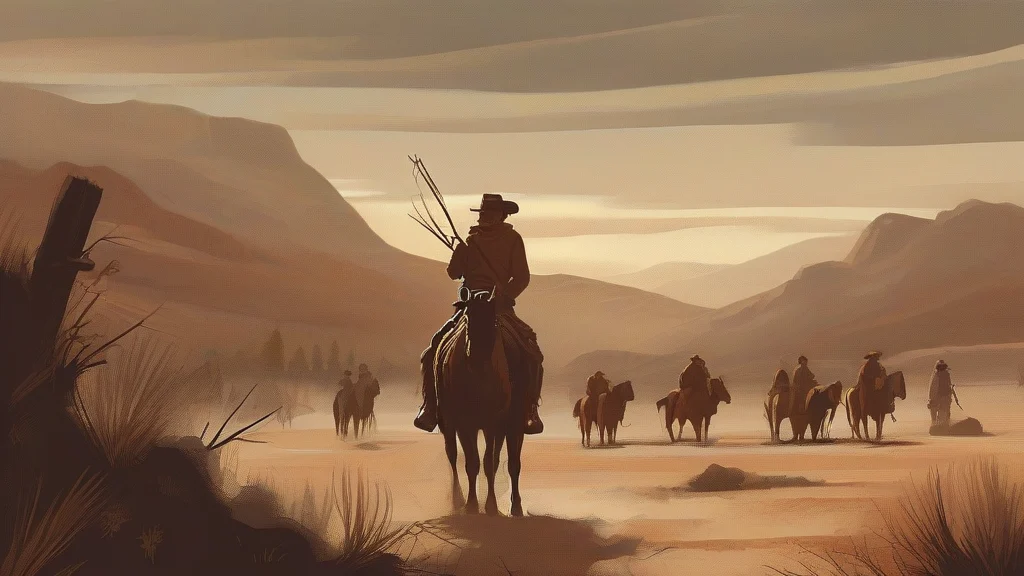
What does frontiersmen mean?
Frontiersmen are the men who lived and worked at the ragged edge of a expanding settlement — hunters, trappers, scouts, and explorers who survived where roads ended and law thinned out. The term is most closely tied to North American history, conjuring figures like Daniel Boone, Davy Crockett, and the mountain men of the Rockies who charted passes and trails before wagons and railroads arrived. The word is used almost exclusively in the plural and carries a romanticized connotation of self-reliance, hardihood, and independence from civilization's comforts. In modern writing it appears mostly in historical, biographical, and cultural commentary about the American frontier era, and by extension it can describe anyone venturing into unexplored territory. Its endurance owes much to folklore and literature, which transformed real backwoodsmen into enduring national symbols of grit and freedom.
nounFrontiersmen are men who live or have lived on the frontier — the sparsely settled outer edge of a territory or civilization — especially those known for self-reliance and rugged outdoor skills.
- A man living and working on the edge of a settled territory, typically skilled in hunting, trapping, and survival in the wild.
- More broadly, any pioneering person who ventures into unmapped or newly opened regions, literal or figurative.
"The frontiersmen of the early American republic blazed trails through the Appalachian wilderness long before settlers followed."
"Davy Crockett remains the archetypal American frontiersman, remembered as much for his coonskin cap as for his courage at the Alamo."
"In the 1820s, frontiersmen like Jim Bridger mapped the Rocky Mountains while working the fur trade."
This is itself the standard plural form; the singular is 'frontiersman'. The plural is by far the more frequently used variant in both speech and writing.
"The frontiersmen traded furs for supplies at the river outpost."
Before there were cowboys, there were frontiersmen — the beaver-trapping, trail-blazing loners who pushed America's edges westward one wilderness at a time.
Reviewed by Deb Chak, Editor. AI-assisted content curated by RJS Tech Solutions LLP.
Etymology of frontiersmen
Frontiersmen is the plural of frontiersman, formed from 'frontier' plus the agent suffix '-man'. The word 'frontier' entered English from Old French 'frontiere', derived ultimately from Latin 'front' meaning forehead or front, and came to mean the borderland of a country in the 15th century before acquiring its distinctive American sense of a moving line of settlement in the 17th and 18th centuries. The compound 'frontiersman' arose in English during this period of westward expansion. Related terms sharing the frontier root include 'frontier', 'borderland', and 'confront'.
Related word forms
How frontiersmen is actually used
The word is almost always used in its plural form and carries a strongly masculine, historical connotation; it evokes the 18th- and 19th-century American West and similar colonial contexts. It is generally used admiringly to suggest ruggedness and independence, though modern usage sometimes critiques the mythos surrounding such figures. The feminine counterpart 'frontierswoman' exists but is far rarer.
Easily confused with frontiersmen
'Frontier' is the border region itself, while 'frontiersmen' are the people who inhabit or explore that region.