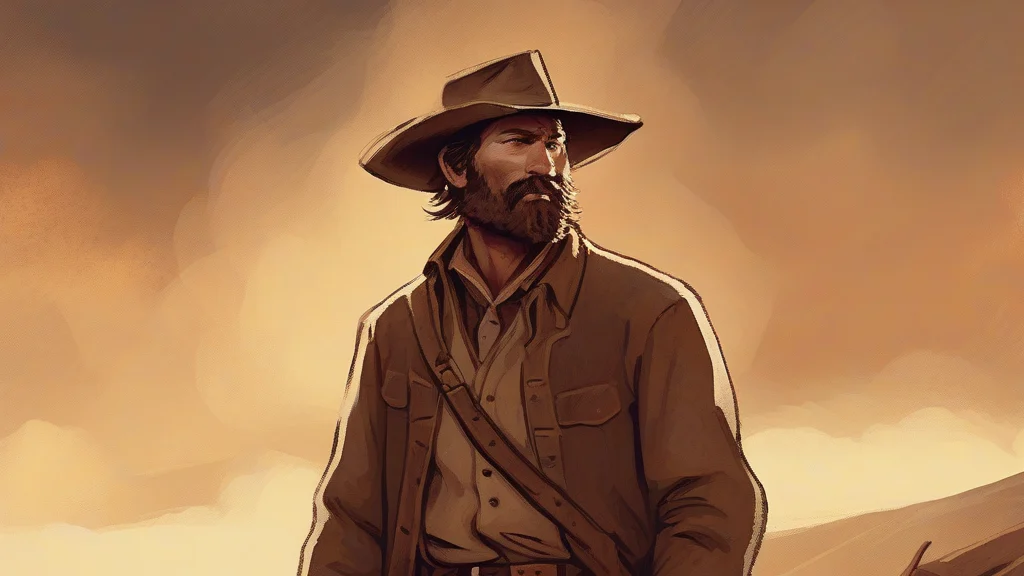
What does frontiersman mean?
A frontiersman is a man who lives at the edge of settled territory — the frontier — where civilization gives way to wilderness. The term is most closely tied to North American history, evoking figures such as Daniel Boone and Davy Crockett who explored, trapped, hunted, and settled lands beyond the established colonies and states during the 18th and 19th centuries. The word carries strong connotations of rugged independence, self-reliance, courage, and resourcefulness, which is why it has become shorthand for a certain idealized image of the American character. In modern usage it can also appear metaphorically, describing someone who breaks new ground in science, business, or the arts. Writers should note that the word is inherently gendered, and neutral alternatives like 'pioneer' are often preferred for broader audiences. It remains an evocative term central to the mythology of the American West.
nounA man who lives in or settles on the frontier, the remote edge of settled territory, especially the American West during the 18th and 19th centuries.
- A man who lives on or near the frontier of settled territory, especially in the American West of the 18th and 19th centuries.
- More broadly, any man skilled at surviving and operating in wild or unsettled country; by extension, a pioneering figure in any field.
"The old frontiersman had spent decades trapping beaver in the Rocky Mountains before any railroad reached the valley."
"As a young frontiersman, Kit Carson learned the languages and trails of the Native American peoples across the Southwest."
"In the history of computing, she proved to be a true frontiersman of the digital age."
The noun is countable and regularly pluralizes; note that the plural drops the singular '-a-' spelling pattern common to some -man nouns and simply becomes 'frontiersmen'.
"The museum's new exhibit honors the frontiersmen who mapped the passes of the Sierra Nevada."
Davy Crockett and Daniel Boone were real frontiersmen whose legends grew so large that even they could barely recognize themselves in the stories told about them.
Reviewed by Deb Chak, Editor. AI-assisted content curated by RJS Tech Solutions LLP.
Etymology of frontiersman
The word 'frontiersman' combines 'frontier', borrowed in the 15th century from the Old French 'frontiere' (the armed border of a realm), itself derived from Latin 'frons', meaning forehead or front, with the Germanic suffix '-man'. It emerged as a distinct term as English-speaking settlement pushed westward in North America, when men living beyond the line of settlement needed a name. Its linguistic cousins include 'front', 'confront', and 'affront', all tracing back to that same Latin root.
Related word forms
How frontiersman is actually used
The word is strongly associated with 19th-century American history and carries connotations of rugged self-reliance and adventure. Because it specifically denotes a man, writers today sometimes choose gender-neutral alternatives such as 'frontier settler' or 'pioneer' when describing mixed groups. The extended figurative use ('a frontiersman of science') is less common but established.
Easily confused with frontiersman
A pioneer is anyone who is among the first to settle or explore a new area, while a frontiersman specifically refers to a man living at the edge of settled territory.
A mountain man was a specific type of frontiersman — typically a fur trapper and explorer of the Rocky Mountains in the early 19th century.