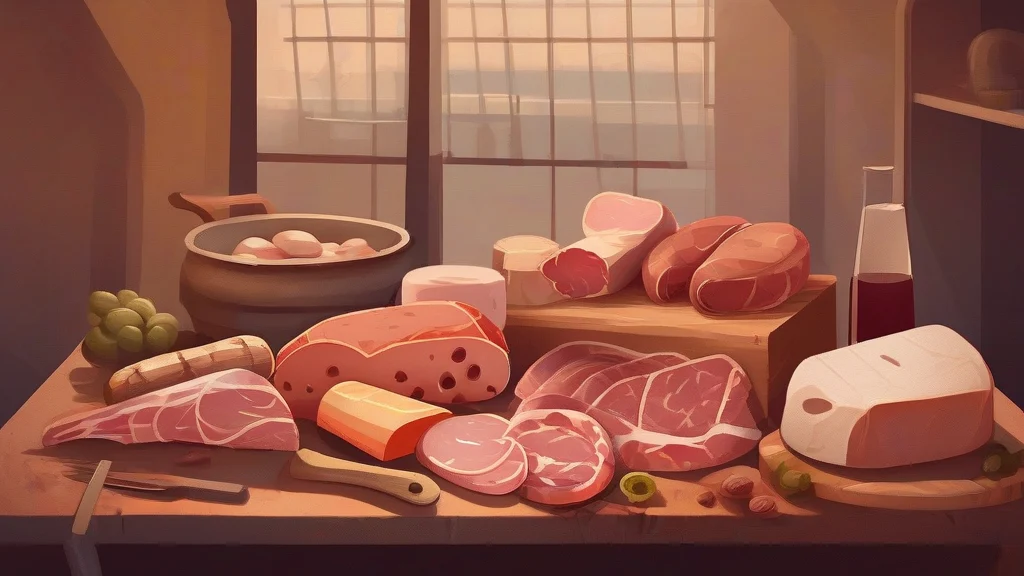
What does charcuterie mean?
Charcuterie refers to prepared, typically cured or cooked meat products — hams, sausages, pâtés, terrines, and rillettes — and, by extension, to the shops or counters that sell them. Borrowed wholesale from French into English in the nineteenth century, the word literally combines the Old French elements for 'flesh' (chair, from Latin caro) and 'cooked' (cuit, from coquere), reflecting a guild tradition of preserving pork before refrigeration existed. Today the most familiar usage is culinary and social: a 'charcuterie board' — an artfully arranged platter of sliced cured meats, often accompanied by cheese, olives, bread, and pickles — has become a staple of restaurants, entertaining, and social media since the 2010s. The word carries connotations of artisanal craftsmanship and continental sophistication, though its casual extension to any snack arrangement has made it a byword for stylish grazing. Its plural, charcuteries, appears mainly when referring to multiple such shops.
nounCold cooked meats collectively; especially a shop or department selling prepared pork products such as ham, sausage, pâté, and terrines. In modern usage it often refers to an artful platter or board of assorted cured meats served as an appetizer.
- Assorted prepared, typically cured or cooked meats, especially served together as an appetizer or on a platter.
- A shop, counter, or trade specializing in such prepared meat products (chiefly in reference to French practice).
"She assembled a charcuterie of prosciutto, chorizo, cornichons, and mustard for the guests."
"The restaurant opened with a generous charcuterie featuring house-cured salami and duck rillettes."
"He trained as a charcutier in Lyon before bringing his craft to London."
Rarely used; mainly appears when referring to multiple charcuterie shops or establishments rather than to the food itself, which is treated as a mass noun.
"The old quarter of the city still holds several traditional charcuteries."
The English never borrowed a translation — we simply kept the entire French word for 'cooked flesh', because Victorian Britain had no shops of its own devoted to it.
Reviewed by Deb Chak, Editor. AI-assisted content curated by RJS Tech Solutions LLP.
Etymology of charcuterie
Charcuterie entered English from French in the mid-nineteenth century, denoting the French trade and products of the charcutier, or pork-butcher. The French term derives from chair cuite, literally 'cooked flesh': chair comes from Latin caro ('flesh, meat'), while cuit comes from Latin coctus, past participle of coquere ('to cook'). It thus shares deep roots with English words like carnal and carrion (from caro) and cuisine and concoction (from coquere). Historically, charcutiers were a distinct Parisian guild, separate from butchers, authorized to sell cooked and preserved pork.
Related word forms
How charcuterie is actually used
Borrowed directly from French and usually italicized in formal writing, though now fully naturalized in English. Since the 2010s, 'charcuterie' has broadened colloquially to describe any decorative grazing board, sometimes including cheeses, fruit, and nuts — a shift some consider loose but which is now widespread. Pronunciation varies between a fully anglicized form and one closer to French.