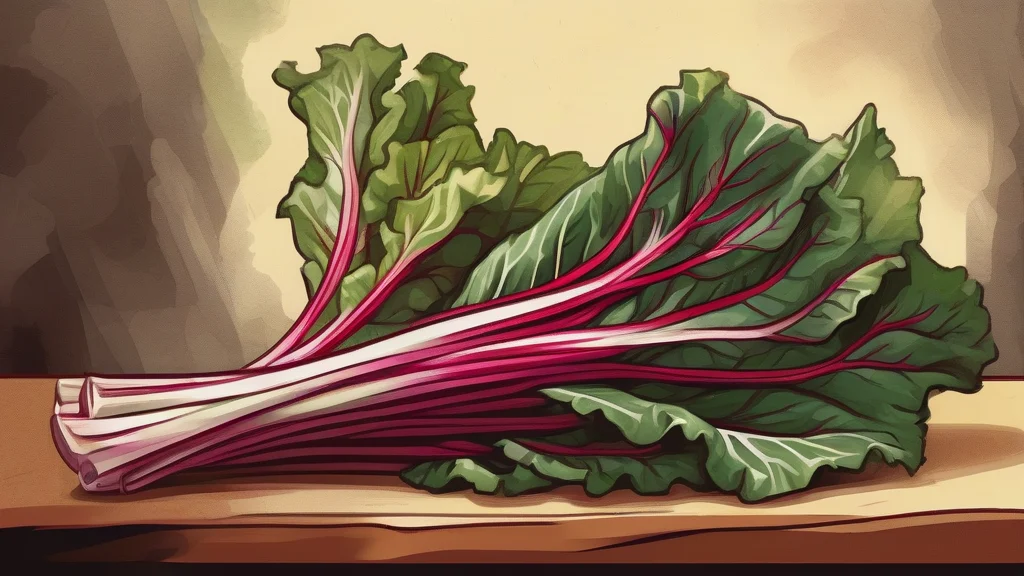
What does chard mean?
Chard is a leafy green vegetable belonging to the same species as the beetroot, Beta vulgaris, though it has been bred for its foliage rather than its root. Its large, glossy dark-green leaves grow from fleshy stalks that may be white, golden, or deep red — the multicolored form being sold as rainbow chard. Both leaves and stems are edible; the leaves cook down much like spinach or kale, while the thicker ribs need slightly longer in the pan. Chard is a staple of Mediterranean cooking, where it appears sautéed with garlic, folded into frittatas and pies, and simmered in soups. Nutritious and easy to grow, it tolerates heat better than many greens and produces a long harvest. In Britain and North America it is usually called Swiss chard, a name whose geographic accuracy is dubious, while Australians more often say silver beet. For cooks and gardeners alike, chard offers a hardy, colorful alternative to spinach.
nounA leafy green vegetable with thick white, red, or yellow stalks and broad dark-green leaves, a variety of beet (Beta vulgaris) cultivated for its edible foliage rather than its root.
- The leafy vegetable Beta vulgaris var. cicla (or flavescens), eaten cooked or raw, with broad leaves and thick edible stalks.
"She sautéed the rainbow chard with garlic and olive oil until the leaves wilted."
"Rainbow chard brings a splash of color to any market stall, with stems in shades of crimson, gold, and ivory."
"Tuscan cooks have long prized cavolo nero and chard as hearty winter greens."
Typically uncountable when referring to the vegetable as food ('a bunch of chard'); the plural 'chards' is rare and used mainly for individual plants.
"The garden bed held a dozen healthy chards ready for cutting."
Despite the name, Swiss chard has no strong ties to Switzerland — botanically it's just a beet bred for its leaves instead of its root.
Reviewed by Deb Chak, Editor. AI-assisted content curated by RJS Tech Solutions LLP.
Etymology of chard
The word 'chard' entered English in the mid-17th century from French 'carde', which originally referred to the edible stalk of an artichoke. The French term derives ultimately from Latin 'carduus', meaning thistle — the same root that gives us 'cardoon', a close relative of the artichoke. Despite the name 'Swiss chard', the vegetable itself was known to the ancient Greeks and Romans, and the 'Swiss' label appears to be a later botanical designation rather than evidence of a Swiss origin.
How chard is actually used
In British English the word often appears in the fuller form 'Swiss chard'; Australian and New Zealand English commonly uses 'silver beet'. The stalks and leaves are both edible but are frequently cooked separately because they soften at different rates.
Easily confused with chard
'Chard' is the leafy vegetable, while 'charred' is the past tense of 'char', meaning burned or scorched.