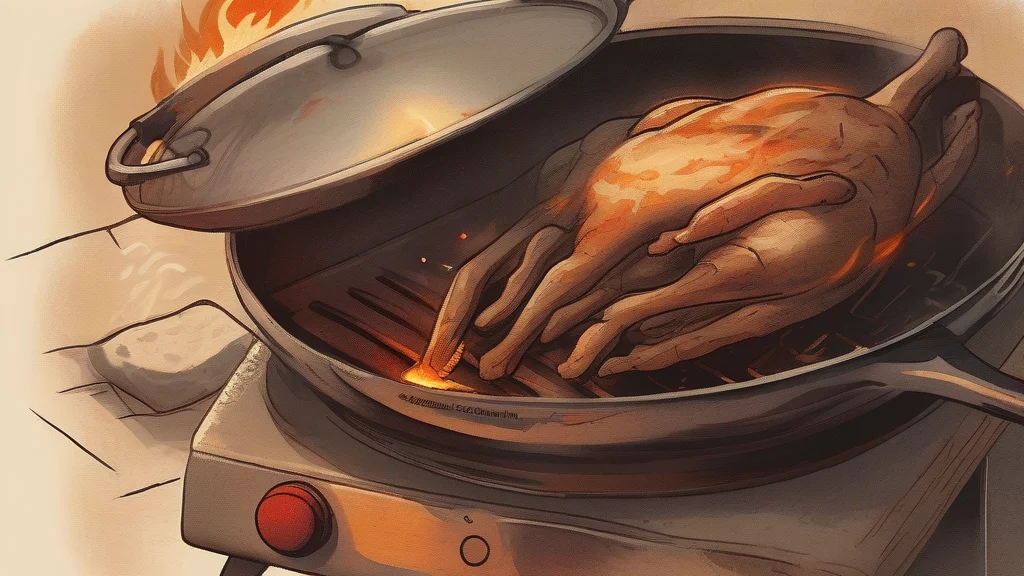
What does charring mean?
"Charring" is the present participle and gerund of the verb "char," meaning to burn or scorch something until its surface turns partially black. The word appears most frequently in cooking, where controlled charring over an open flame or hot pan is prized for the smoky depth and slight bitterness it imparts to foods like peppers, corn, eggplant, and citrus. Beyond the kitchen, charring often carries a connotation of damage or neglect, describing wood, paper, or structures blackened by fire or excessive heat. The process is distinct from complete combustion: a charred object is burned at the surface but retains its shape and much of its substance underneath. Related terms include the adjective "charred" and compounds such as "char-grilled." Whether describing a deliberate culinary technique or the aftermath of an accidental burn, "charring" precisely captures that intermediate state between whole and consumed.
Present participle of "char": to burn or scorch something so that its surface becomes blackened.
"The flames were charring the edges of the wooden fence."
Often used in progressive constructions describing ongoing burning.
The action or process of burning something so that its surface blackens; the state of being charred.
"Light charring gives grilled vegetables their distinctive smoky flavor."
Used chiefly as a gerund; common in food writing.
That smoky, blistered edge on your roasted pepper isn't a mistake — charring deliberately transforms flavor, turning simple vegetables into something deep and complex.
Reviewed by Deb Chak, Editor. AI-assisted content curated by RJS Tech Solutions LLP.
Etymology of charring
The verb "char" meaning to scorch is first attested around the mid-17th century, apparently as a phonetic variant or shortened form related to "char" in older senses of turn or work, though its exact origin is debated among lexicographers. It should not be confused with the unrelated verb "char" meaning to do housework, which comes from Old English "cierran" (to turn) and survives in words like "charwoman." The cooking-related sense has grown dominant in modern English alongside compounds like "charcoal," itself an ancient word combining "char" with "coal."
Related word forms
How charring is actually used
In modern usage, "charring" appears most often in culinary contexts, where deliberate light charring is considered desirable for adding smoky flavor; outside cooking, it usually implies damage or accident. It functions both as a progressive verb form and as a gerund (e.g., "charring adds bitterness").
Easily confused with charring
"Charting" means plotting or recording information on a chart, while "charring" means burning or scorching a surface black.