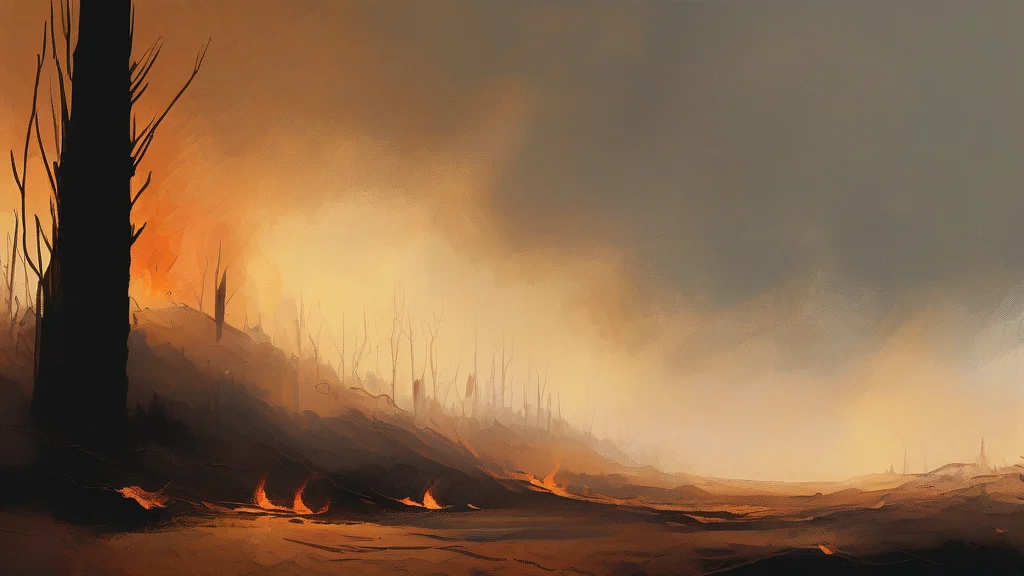
What does charred mean?
"Charred" describes something burnt and blackened on its surface by fire or intense heat — a house's charred timbers after a blaze, or the charred crust on a piece of toast forgotten under the grill. It is the past participle of the verb "char," which itself lies at the heart of "charcoal": wood that has been turned, or converted, into coal-like fuel. In everyday use, the word often appears in sober contexts such as news reports of fires, where phrases like "charred remains" or "charred ruins" evoke destruction and loss. Yet in modern kitchens it has taken on a far more appetizing role: chefs deliberately char peppers, corn, and meat over high flames to develop smoky, bitter-sweet depth of flavour, and cookbooks routinely call for ingredients to be "lightly charred." This split personality — devastation in one context, culinary craft in another — makes "charred" a vivid, versatile word worth knowing.
adjective (past participle of the verb 'char')Burnt and blackened on the surface by fire or intense heat; scorched so as to turn black and crusty.
- Blackened or burnt on the surface by fire, heat, or burning (of objects, food, buildings).
- (Of food, especially vegetables or meat) deliberately cooked over high heat until lightly blackened for flavour.
"The firefighters emerged coughing, their jackets charred and smoking."
"Rescuers picked through the charred wreckage of the barn at dawn."
"The chef served blistered, charred peppers drizzled with olive oil."
The same little verb behind 'charred' gave us 'charcoal' — wood literally turned into coal — and even hides inside 'ajar', a door left turned slightly open.
Reviewed by Deb Chak, Editor. AI-assisted content curated by RJS Tech Solutions LLP.
Etymology of charred
The verb "char" (to burn slightly) is first recorded in English around the late 17th century, though its deeper origin is debated. A widely accepted account derives it from the same root as "charcoal" — literally wood turned into coal — tracing back to Old English "cierran," meaning "to turn." That root also survives in "ajar," originally meaning a door turned slightly open, giving these everyday words a shared ancient ancestry.
Related word forms
How charred is actually used
Often carries somber connotations when describing fire damage ('charred remains', 'charred ruins'), but in culinary contexts it is positive, signalling deliberate smoky flavour. 'Lightly charred' is standard in food writing to distinguish intentional browning from accidental burning.
Easily confused with charred
'Charged' means filled with electricity, emotion, or an accusation, whereas 'charred' means burnt and blackened — they differ by one letter but share nothing in meaning.