What does charwoman mean?
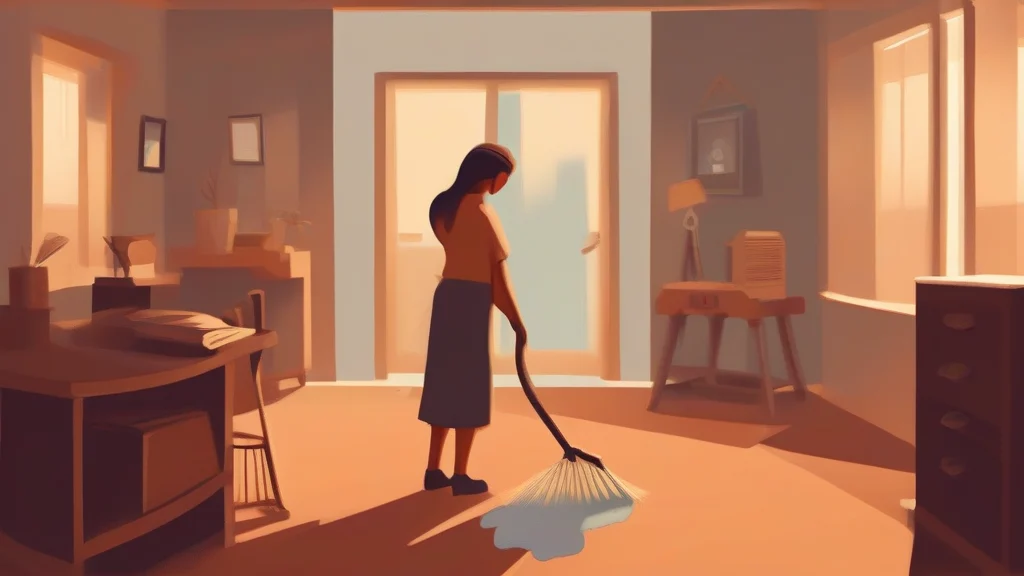
A charwoman is a woman employed to do cleaning work — scrubbing floors, dusting, and tidying — in private homes, offices, or public buildings. Unlike a live-in maid, she typically worked by the day or for a few hours at a time, often moving between several households. The word combines 'char', an old term meaning a chore or turn of work that survives today in 'chore', with 'woman'. Once a common fixture of everyday speech in Britain and America, particularly from the 18th through early 20th centuries, it now sounds dated and even slightly condescending, and modern usage favors neutral terms such as 'cleaner' or 'cleaning lady'. It remains valuable to readers of older literature, where charwomen frequently appear as background figures in works by Dickens and other Victorian writers. The plural follows 'woman': charwomen.
nounA woman employed to clean houses or offices, typically on a part-time or daily basis rather than living in as a servant.
- A woman employed to clean houses or offices, especially on a part-time or daily basis rather than living in as a domestic servant.
"Every morning the charwoman arrived at dawn to scrub the office floors before the staff arrived."
"The charwoman let herself in each morning and had the offices spotless before anyone arrived."
"In Dickens's London, a poor charwoman might clean several households in a single day to earn enough for bread."
Follows the irregular plural of 'woman'; 'charwomans' is incorrect.
"Two charwomen shared the heavy workload of the great house."
'Char' in charwoman comes from an Old English word for a 'turn' of work — the same root that gave us the humble word 'chore'.
Reviewed by Deb Chak, Editor. AI-assisted content curated by RJS Tech Solutions LLP.
Etymology of charwoman
The word 'charwoman' derives from 'char' (also spelled 'chare'), a Middle English term meaning a piece of work or task, which itself traces back to Old English 'cerr', meaning a turn or occasion. The compound 'charwoman' arose to describe women hired to perform such day-to-day cleaning tasks, and it became common from around the late 17th century onward. The same root 'char' survives independently in the verb 'to char' (to do cleaning work) and, via a different development path, gave English the word 'chore'. It is unrelated to the 'char' meaning to burn or scorch.
How charwoman is actually used
The word is now largely dated or historical in both British and American English, having been replaced by neutral terms like 'cleaner' or 'cleaning lady'. It carries a distinctly old-fashioned, sometimes class-inflected connotation, evoking Victorian or early 20th-century domestic service. The plural is irregular: 'charwomen', not 'charwomans'.
Easily confused with charwoman
A chairwoman is a woman who presides over a meeting or organization, whereas a charwoman is a woman hired to clean.