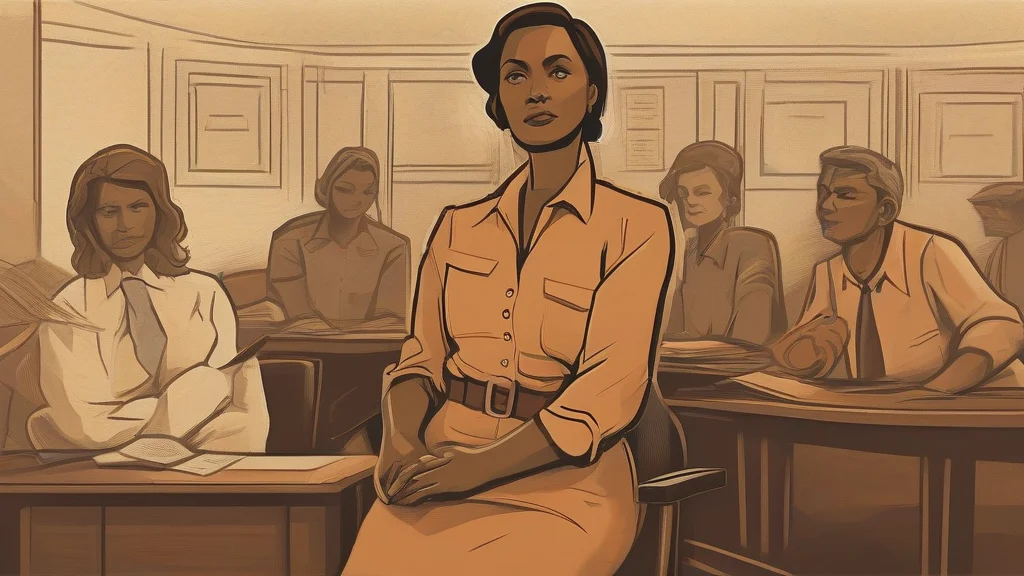
What does forewoman mean?
A forewoman is a woman who holds a position of leadership within a group — most commonly the woman chosen to preside over a jury and speak its verdict, but also a woman placed in charge of supervising workers, such as a factory floor or work crew. The word pairs the directional prefix 'fore-' (meaning 'in front' or 'leading') with 'woman', making it the feminine counterpart of the older term 'foreman'. In courtrooms, the forewoman occupies a role of real consequence: she coordinates deliberations, communicates with the judge, and announces the jury's decision. In industrial and workplace settings historically dominated by male supervisors, 'forewoman' designated a woman entrusted with directing labor and maintaining standards. Today, many institutions favor the gender-neutral 'foreperson', yet forewoman remains standard where the specific identity of the leader is being stated or emphasized.
nounA woman who serves as the leader, supervisor, or chair of a group, especially a woman foreperson of a jury or a woman in charge of a crew of workers.
- A woman who presides over a deliberative body, especially a jury, as its foreperson.
- A woman who supervises and directs a group of workers, such as a crew, shift, or department.
"The jury's forewoman rose to read the verdict aloud."
"After two days of deliberation, the forewoman handed the sealed verdict to the judge."
"As forewoman of the stitching room, she oversaw a dozen seamstresses and set the daily quotas."
The plural follows the irregular -en ending typical of 'woman'-based compounds, mirroring 'women' rather than 'womans'.
"Both forewomen reported that their juries had reached unanimous decisions."
Long before 'gender-neutral language' was a buzzword, English speakers simply added '-woman' to job titles — and forewoman has been quietly running juries and factory floors since at least the 1500s.
Reviewed by Deb Chak, Editor. AI-assisted content curated by RJS Tech Solutions LLP.
Etymology of forewoman
The word derives from the prefix 'fore-', meaning 'before' or 'in front', combined with 'woman'. It is the feminine counterpart of 'foreman', which dates from late medieval English and originally denoted the leading or first man of a group. As women entered supervisory and civic leadership roles, English speakers formed parallel titles by substituting '-woman', producing forewoman by roughly the sixteenth century. It shares this pattern with other gendered counterparts of 'foreman' rather than deriving from any classical root; related words are therefore other compounds built on 'fore-'.
Related word forms
How forewoman is actually used
Forewoman is the explicitly feminine form of foreman; in contemporary usage, the gender-neutral term 'foreperson' is increasingly preferred in legal and workplace contexts. The word carries a tone of authority and responsibility, whether in a courtroom or on a shop floor.
Easily confused with forewoman
Foreman is the traditional male-oriented or generic term for the same role, while forewoman specifically denotes a woman holding it.