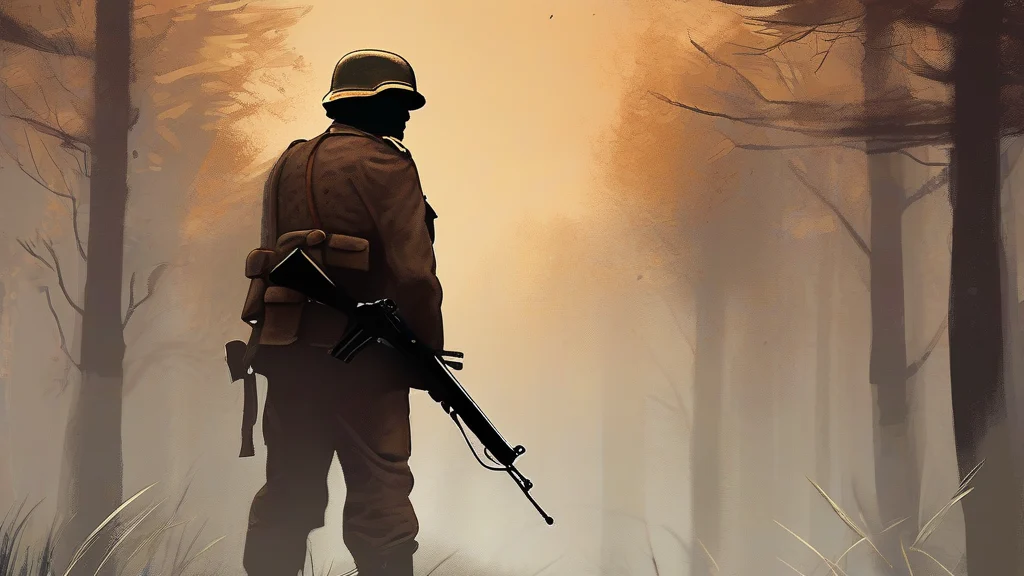
What does chasseur mean?
A chasseur is a light-armed soldier belonging to a skirmishing or rifle corps — the term is most closely associated with the French army, whose chasseurs à pied and chasseurs à cheval were celebrated as fast-moving, sharpshooting troops. More broadly, the word simply means a hunter, reflecting its French origin in the verb chasser, 'to hunt.' In French-speaking countries a chasseur may also be a hotel employee who runs messages and errands. English speakers today are most likely to meet the word on a menu: dishes described as 'chasseur' are prepared 'hunter-style,' usually with mushrooms, shallots, herbs, and white wine, as in chicken chasseur or sauce chasseur. The word carries a distinctly Continental, somewhat old-world flavor — evoking both military dash and rustic hunting cookery — which makes it useful for writers seeking precise historical or culinary color.
nounA chasseur is a soldier in a light-infantry or rifle unit, especially one of the specialized light troops of the French army; it can also mean a hunter, or (in French usage) a hotel attendant who runs errands for guests.
- A member of a light-infantry or rifle corps, especially in the French army.
- A hunter.
- (In French usage) A hotel servant or attendant who runs messages and errands for guests.
- (Cookery, as an adjective) Prepared in the manner of a hunter's dish — typically with mushrooms, shallots, herbs, and white wine.
"The regiment's chasseurs moved swiftly through the forest, screening the main column from enemy scouts."
"The chasseurs advanced ahead of the main force, using the cover of the woods."
"She ordered the chicken chasseur, served in a rich mushroom and white-wine sauce."
Standard English plural; the French plural is identical in form.
"The valley had been scouted by chasseurs at first light."
The same word that once named Napoleon's swift-footed light troops now names your dinner — order something 'chasseur' and you're eating it 'hunter-style,' with mushrooms.
Reviewed by Deb Chak, Editor. AI-assisted content curated by RJS Tech Solutions LLP.
Etymology of chasseur
Chasseur comes from French chasser, 'to hunt,' itself from Vulgar Latin *captiare, a frequentative of Latin capere, 'to seize.' It entered English around the late 17th to early 18th century, first as a term for hunters and then for the light-infantry soldiers named after them. It shares its deep origin with the English words 'chase,' 'catch,' and 'cache.'
Related word forms
How chasseur is actually used
The military sense is largely historical outside discussions of European armies, where it survives as a designation for certain French and other continental light-infantry units. The cookery sense ('chicken chasseur', 'sauce chasseur') is common on menus and is treated adjectivally. The hotel-servant sense is chiefly encountered in French contexts or older literature.
Easily confused with chasseur
'Chassee' (or chassé) is a ballet gliding step, whereas 'chasseur' refers to a light-infantry soldier, a hunter, or a style of sauce.