
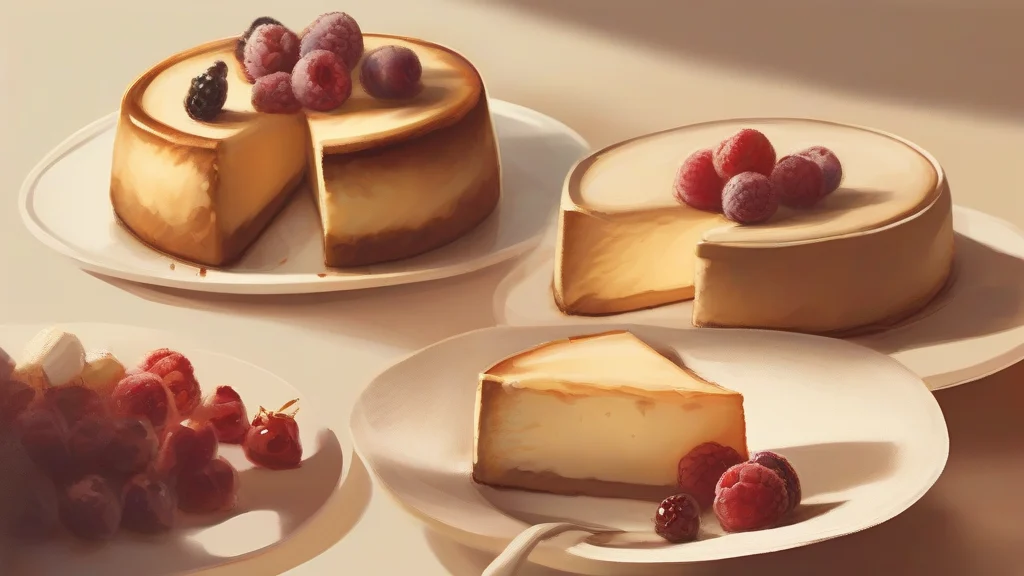
What does cheesecake mean?
Cheesecake is a noun denoting one of the world's most beloved desserts: a dense, creamy confection made from cream cheese — or, in traditional versions, curd or ricotta-style cheese — blended with sugar and eggs and set atop a crumbly biscuit or pastry base. Styles vary widely, from the rich, heavy baked New York cheesecake to lighter, no-bake or chilled varieties common in Britain and elsewhere, often crowned with fruit, chocolate, or sauce. The word is a transparent compound of 'cheese' and 'cake', reflecting a lineage that stretches back to ancient Greece. Beyond the kitchen, 'cheesecake' has a secondary, now largely dated meaning: photographic or cinematic imagery of women posed to be alluring rather than explicit, popular in mid-twentieth-century pin-up culture. Whether describing dessert menus or vintage media, the word evokes indulgence, comfort, and a certain retro charm.
A rich sweet dessert consisting of a cream cheese or curd-cheese layer on a crumbly biscuit or pastry base, often topped with fruit.
"For her birthday she asked for a lemon cheesecake instead of a cake."
Countable when referring to whole desserts ('three cheesecakes'); uncountable when referring to the food in general ('a slice of cheesecake').
(dated, informal) Photographs or portrayals of a woman in a sexually alluring but non-explicit manner; such material generally.
"The studio churned out war-era posters full of cheerful cheesecake."
Chiefly used of mid-20th-century American pop culture; the parallel term for men is 'beefcake'.
Used when referring to multiple whole desserts; as a mass noun referring to the food itself, no plural is used.
"The café displayed a row of miniature cheesecakes behind the glass."
Cheesecake is older than the Roman Empire — ancient Greeks were baking a version of it over two thousand years ago.
Reviewed by Deb Chak, Editor. AI-assisted content curated by RJS Tech Solutions LLP.
Etymology of cheesecake
Cheesecake is a straightforward compound of 'cheese', from Old English 'cīese' (ultimately from Latin 'caseus'), and 'cake', from Old Norse 'kaka'. Desserts made with cheese and honey date back to ancient Greece — the word's culinary ancestry far predates its English form — and cheese-based cakes appear in Roman sources such as Cato the Elder's writings. The compound entered Middle English in the medieval period and has been in continuous use since. Its figurative sense for suggestive female imagery arose in early twentieth-century American slang.
Related word forms
How cheesecake is actually used
In British English the base is usually called a 'biscuit' base, while American English uses 'crust'. The figurative 'cheesecake' sense (suggestive imagery) is dated and chiefly historical, largely confined to mid-20th-century contexts; its masculine counterpart is 'beefcake'.
Easily confused with cheesecake
A flan is a custard dessert set with caramel, whereas a cheesecake is built around a cream cheese or curd-cheese filling.