What does cherry mean?
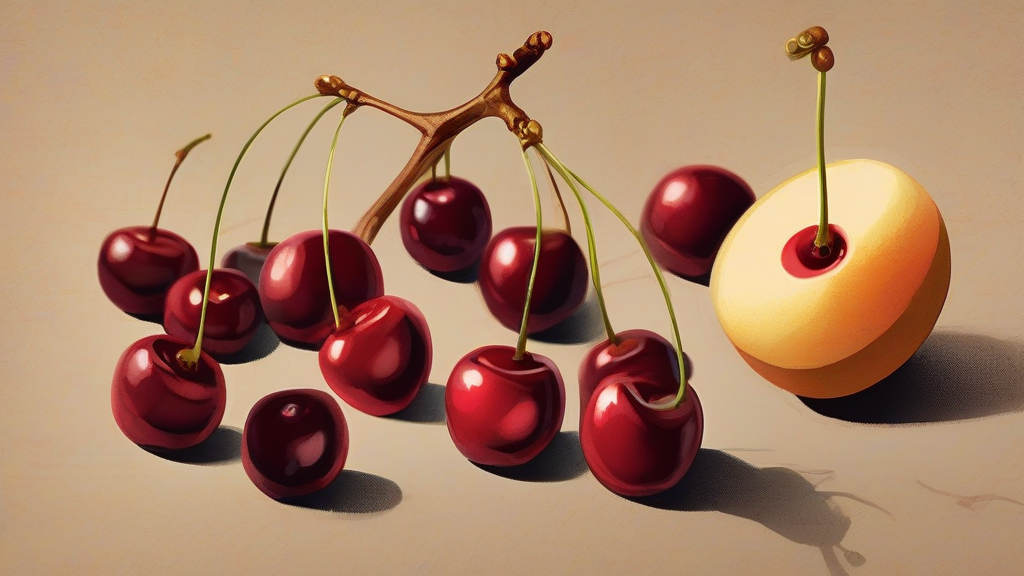
The cherry is a small, round stone fruit — technically a drupe — with smooth skin ranging from bright red to deep purple-black, enclosing juicy flesh around a single hard pit. It grows on trees of the genus Prunus and comes in two broad culinary types: sweet cherries, often eaten fresh, and sour (tart) cherries, favoured for pies, jams, and preserves. The word also denotes the tree itself and its fine-grained, reddish-brown timber, which has long been prized by cabinetmakers. Cherries carry rich connotations: they signal summer, freshness, and indulgence in phrases like "the cherry on top," while their brief seasonal availability lends them an air of specialness. Cultivated since antiquity and beloved worldwide, the cherry occupies a firm place both in the kitchen — from clafoutis to cocktails garnished with maraschino cherries — and in cultural imagery, where it stands for ripeness, beauty, and fleeting delight.
A small, round stone fruit with red or dark-red skin, sweet or tart flesh, and a single hard pit.
"She bought a punnet of cherries at the market."
Most commonly used in this sense; the plural "cherries" is standard.
The deciduous tree or shrub of the genus Prunus that bears this fruit, or its fine-grained timber.
"The orchard was full of blossoming cherry trees in spring."
When referring to the wood, often used attributively, as in "a cherry wardrobe."
Of a vivid red colour resembling that of a ripe cherry; also used attributively to mean made of or flavoured with cherries.
"She wore a cherry-red scarf against the grey coat."
Usually hyphenated in compounds such as "cherry-red" or "cherry-flavoured."
The plural is regular: one cherry, two cherries. It applies to the fruit and, less commonly, to the trees themselves.
"We picked two baskets of cherries from the old tree behind the house."
"Cherry" comes from the same ancient root as "cerise" — the French word for cherry — and traces back to a Greek city, Kerasos, famous for its fruit trees.
Reviewed by Deb Chak, Editor. AI-assisted content curated by RJS Tech Solutions LLP.
Etymology of cherry
English borrowed "cherry" from Anglo-Norman French "cherise", which itself derives from Latin "cerasum" (later "ceresium"), referring to the fruit of the Cerasus region in Pontus, Asia Minor — modern-day Giresun in Turkey. Because speakers misheard the French singular as a plural, the final -s was dropped, giving Middle English "chiri" or "cherry." Related forms survive in French "cerise" and German "Kirsche," and the compound "kirschwasser" preserves the older Germanic borrowing directly.
Related word forms
How cherry is actually used
In everyday speech, "cherry" most often refers to the fruit. In British English, the word can also appear informally in idioms such as "a bowl of cherries," meaning life's pleasures. The plural form "cherries" is standard in all registers.
Easily confused with cherry
A cherry is a drupe (a stone fruit with a hard pit), whereas a berry is a fleshy fruit produced from a single ovary and typically containing multiple seeds.