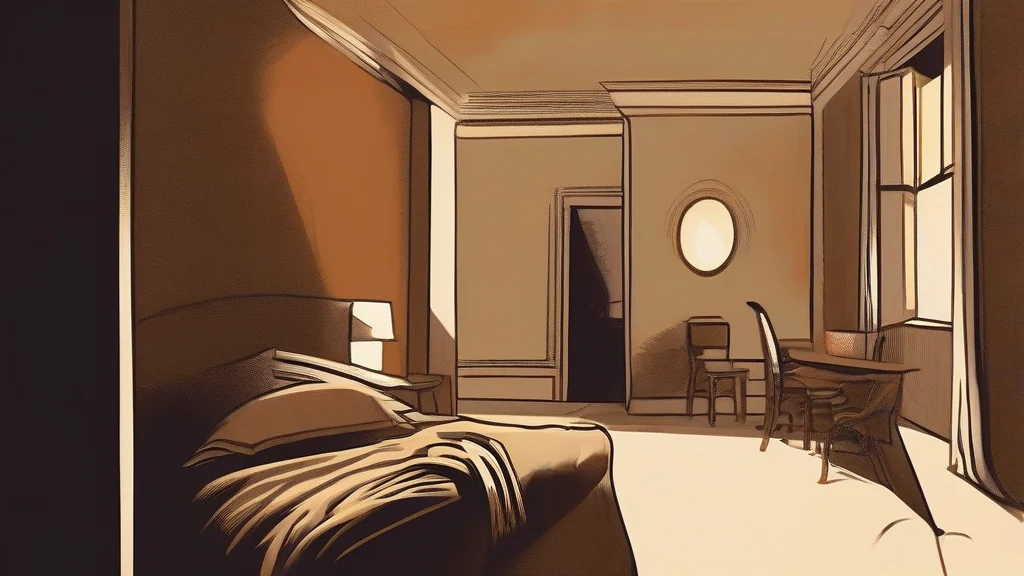
What does chiaroscuro mean?
Chiaroscuro refers to the artistic treatment of light and shade — the deliberate contrast between illuminated areas and shadowed ones in a drawing, painting, photograph, or other image. Borrowed from Italian, where it combines 'chiaro' (bright or clear) and 'oscuro' (dark), the term entered English in the seventeenth century alongside the great age of Baroque painting. Artists such as Caravaggio and Rembrandt became famous for exploiting stark contrasts of light and dark to model three-dimensional form, focus attention on a subject, and lend scenes a powerful sense of drama. In modern usage the word extends beyond painting to photography, film lighting, and even figurative descriptions of works marked by an interplay of brightness and gloom, literal or moral. Chiaroscuro remains a staple of art-historical writing and a useful word for anyone discussing how images are lit.
nounThe treatment of light and shade in drawing and painting; an effect of contrasted light and shadow, especially one used to create depth or dramatic atmosphere.
- The use of strong contrasts between light and dark in painting or drawing to model forms or create drama.
- A work or effect characterized by such contrasted light and shadow (e.g. 'a chiaroscuro').
"Rembrandt's portraits are celebrated for their masterful chiaroscuro."
"Vermeer's interiors achieve a quiet chiaroscuro, with daylight falling softly across a wall."
"The photographer used harsh side-lighting to produce a striking chiaroscuro."
Rarely pluralized; the word usually functions as an uncountable noun denoting a technique or quality rather than countable objects. When a countable sense is needed (individual effects or works), the regular plural 'chiaroscuros' applies.
"The exhibition gathered chiaroscuros by artists across three centuries."
Caravaggio's chiaroscuro was so dark and theatrical that art historians gave his style its own name: tenebrism, from the Italian for 'murky darkness'.
Reviewed by Deb Chak, Editor. AI-assisted content curated by RJS Tech Solutions LLP.
Etymology of chiaroscuro
Chiaroscuro comes from Italian, formed from 'chiaro' meaning clear or bright and 'oscuro' meaning dark, both ultimately from Latin ('clarus' and 'obscurus'). The term entered English in the mid-seventeenth century as writers sought vocabulary to discuss the dramatic lighting techniques of Baroque painters. Its Latin roots also give English the related words 'clarion' and 'clear' from clarus, and 'obscure' from obscurus.
How chiaroscuro is actually used
A technical term of art history and criticism, but widely understood in general writing about visual art. It can also be applied figuratively — for example, describing a novel's interplay of moral light and darkness — though such extended uses should be handled with care to avoid sounding pretentious.
Easily confused with chiaroscuro
Chiaroscuro concerns strong contrasts between light and dark, whereas sfumato is Leonardo da Vinci's technique of blending tones so subtly that edges soften into haze.