What does chili mean?
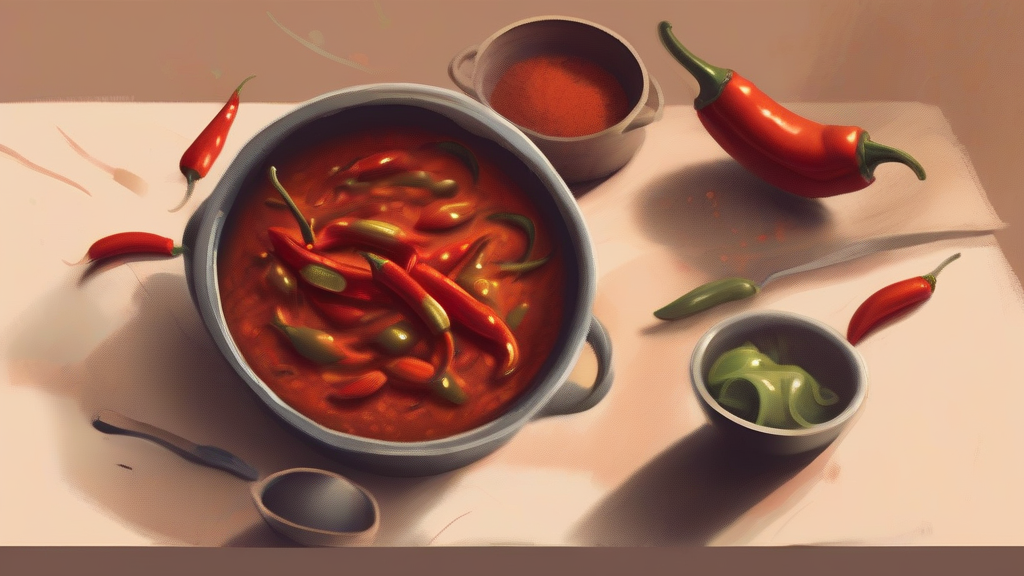
Chili refers primarily to the fiery fruit of plants of the Capsicum genus — what botanists call a berry but cooks everywhere treat as a vegetable and spice. Chilies range from mildly warm to blisteringly hot, their heat coming from capsaicin, and they are indispensable to cuisines from Mexico to Thailand to India. In American English the word is also applied to chili con carne, a hearty stew of meat, peppers, and spices that became a signature dish of Texas. Spelling varies: Americans write 'chili', Britons prefer 'chilli', and the American Southwest favors the Spanish-influenced 'chile'. The word entered European languages through Spanish, which borrowed it from Nahuatl, the Aztec language — a reminder that chilies are native to the Americas and were unknown outside them before the Columbian exchange. Versatile, vivid, and occasionally incendiary, chili is a word every cook needs.
nounA hot pepper of the Capsicum family, used fresh or dried to add pungent heat to food; also, chiefly in British usage and in American Southwest cuisine, a dish (chili con carne) of stewed meat, peppers, and often beans.
- A hot pepper of any variety of the Capsicum genus, especially the small, intensely pungent types used to season food.
- (chiefly British, as 'chili' or 'chilli') A dish of stewed minced beef with chilies and other ingredients; in the US, chili con carne.
"She stirred a chopped chili into the curry for an extra kick."
"The recipe calls for two red chilies, finely sliced."
"On cold evenings nothing beats a bowl of steaming chili topped with cheese."
American English spells the plural 'chilies'; British English prefers 'chillies'. Both are fully standard within their regions.
"The market stalls were heaped with green and red chilies of every size."
The word 'chili' comes straight from Nahuatl, the language of the Aztecs — making it one of the oldest food words in the Americas, centuries older than Columbus's arrival.
Reviewed by Deb Chak, Editor. AI-assisted content curated by RJS Tech Solutions LLP.
Etymology of chili
Chili was borrowed into English via Spanish 'chile', which itself came directly from Nahuatl 'chīlli', the Aztec word for the pepper. The word thus predates European contact with the Americas and reflects the pepper's Mexican origins. It has been part of English since at least the seventeenth century, when Spanish accounts of New World foods reached Britain. Its variant spellings — chilli in British usage, chile in the American Southwest — preserve different stages of the borrowing from Spanish.
How chili is actually used
Spelling varies by region: 'chili' is standard in American English, 'chilli' is standard in British English, and 'chile' is common in the American Southwest. The plural is normally 'chilies' (US) or 'chillies' (UK). The word is informal-to-neutral in register and appears constantly in culinary contexts.
Easily confused with chili
Chili is a noun meaning a hot pepper or a spicy stew, while chilly is an adjective describing uncomfortably cold weather.
Chile is simply the Spanish-derived spelling of the same pepper, preferred in American Southwestern English, whereas chili is the standard American spelling — though Chile is also the name of a South American country.