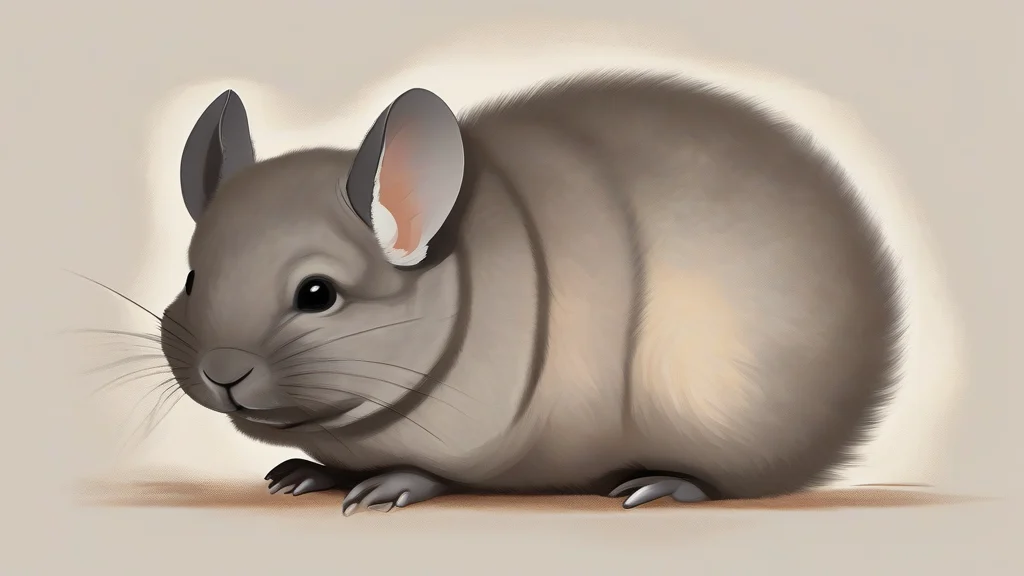
What does chinchilla mean?
A chinchilla is a small rodent native to the high Andes of South America, renowned for possessing one of the softest and densest coats of any mammal — so dense that fleas cannot survive on it, and so luxurious that demand for its fur drove wild populations close to extinction. The word refers both to the animal itself, now protected in the wild and widely bred as an exotic pet, and to its pelt when used in garments such as coats and stoles. In everyday use, calling something "chinchilla" connotes opulence and rarity, since genuine chinchilla fur remains among the most expensive materials in fashion. The word entered English in the early seventeenth century via Spanish, ultimately deriving from the name of the Chincha people of pre-Columbian Peru, in whose region the animals were found. Today the term appears most often in contexts of pets, wildlife conservation, and luxury clothing.
A small, crepuscular rodent native to the Andes, having very soft dense grey fur; the animal itself, whether wild, farmed, or kept as a pet.
"A chinchilla can leap more than a metre high when startled."
Plural: chinchillas.
The soft, dense grey pelt of the chinchilla, used as a luxury fur in clothing.
"The actress wore a floor-length chinchilla to the premiere."
In this sense "chinchilla" behaves as a mass noun and takes no plural.
Regular plural, applied only to the animal sense; the fur sense is an uncountable mass noun.
"Wild chinchillas live in rocky burrows at high elevations in the Andes."
A single chinchilla follicle sprouts up to 60 hairs — which is why its coat feels like touching a cloud, and why humans nearly hunted it to extinction for fashion.
Reviewed by Deb Chak, Editor. AI-assisted content curated by RJS Tech Solutions LLP.
Etymology of chinchilla
The word "chinchilla" comes from Spanish, first recorded in English in the early seventeenth century. It derives from the name of the Chincha, an indigenous Andean people whose region of what is now Peru was home to the animals, with the Spanish diminutive suffix -illa attached. Cognates appear in other European languages that borrowed the same Spanish term, including French "chinche" connections aside, forms like German "Chinchilla" and Italian "chinchillà," all reflecting the same source.
How chinchilla is actually used
"Chinchilla" functions as both the singular animal name and, unmarked, as a mass noun for its fur (e.g., "a coat trimmed with chinchilla"). The plural is "chinchillas." As a pet it is popular but high-maintenance, requiring cool temperatures and dust baths.