
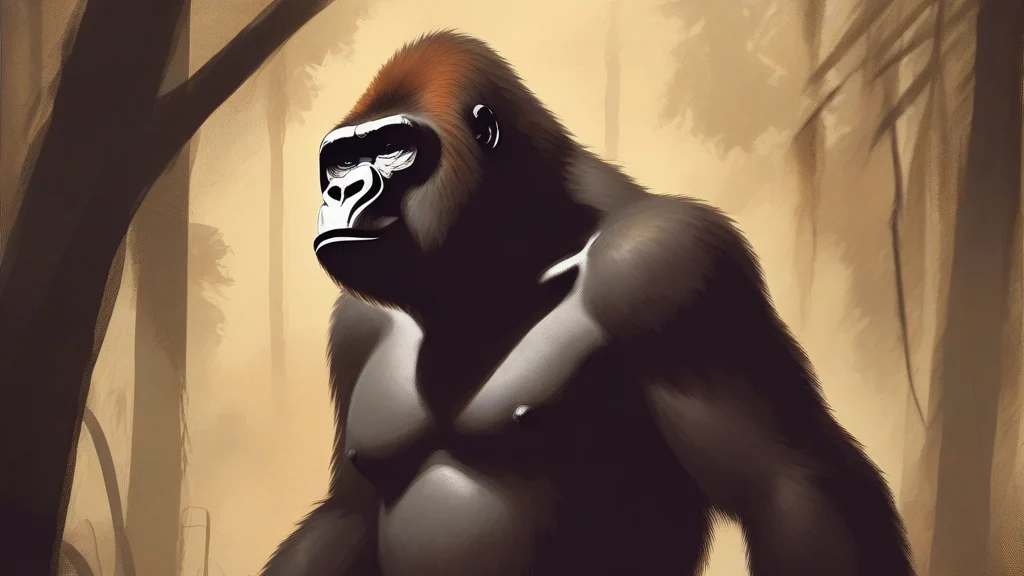
What does gorilla mean?
“Gorilla” most often refers to one of the great apes in the genus Gorilla, the largest living primates. Wild gorillas inhabit tropical forests in equatorial Africa and live in organized social groups usually led by a mature male called a silverback. Their diet is largely herbivorous, although they occasionally eat insects and other small animals. In informal English, the word can describe a person who is exceptionally large, powerful, intimidating, or aggressive. As a verb, “to gorilla” means to guard, escort, or closely watch a person or group, especially for protection. These older and newer usages coexist: the animal remains the dominant meaning, while the personal and protective senses are typically informal. The word entered English in the early modern period through Latin and ultimately has an uncertain origin in an ancient report of hairy African creatures.
A large great ape of the genus Gorilla, native to tropical forests of equatorial Africa. Informally, it can also mean a large, powerful, or aggressive person.
"The mountain gorilla was feeding among the dense vegetation."
The informal personal sense is often derogatory. The ordinary plural is gorillas.
To guard, escort, or closely watch a person or group, especially as a bodyguard or security detail.
"Several officers gorilled the candidate through the hotel."
This verb is informal and is chiefly associated with police, security, and protective work.
Use gorillas for more than one ape; gorilla may also function collectively for the species or kind.
"The gorillas defended their territory from a neighboring group."
Gorillas are the largest living primates, but their imposing size conceals a famously peaceful and carefully structured social life.
Reviewed by Deb Chak, Editor. AI-assisted content curated by RJS Tech Solutions LLP.
Where does gorilla come from?
English borrowed gorilla from Modern Latin in the 17th century. The Latin term is associated with a name for a hairy creature reported by Hanno, the ancient Carthaginian navigator, although the ultimate origin of that name is uncertain. The English animal sense developed from this early usage, while the personal and verb senses arose much later in informal language.
Related word forms
How gorilla is actually used
As an animal, gorilla may be singular for one ape or collective for the species. The informal sense describing a person is often insulting or confrontational. The verb is informal and chiefly associated with police, security, and bodyguard work.
Easily confused with gorilla
A guerrilla is a member of an irregular force engaged in guerrilla warfare, whereas a gorilla is primarily a great ape.