
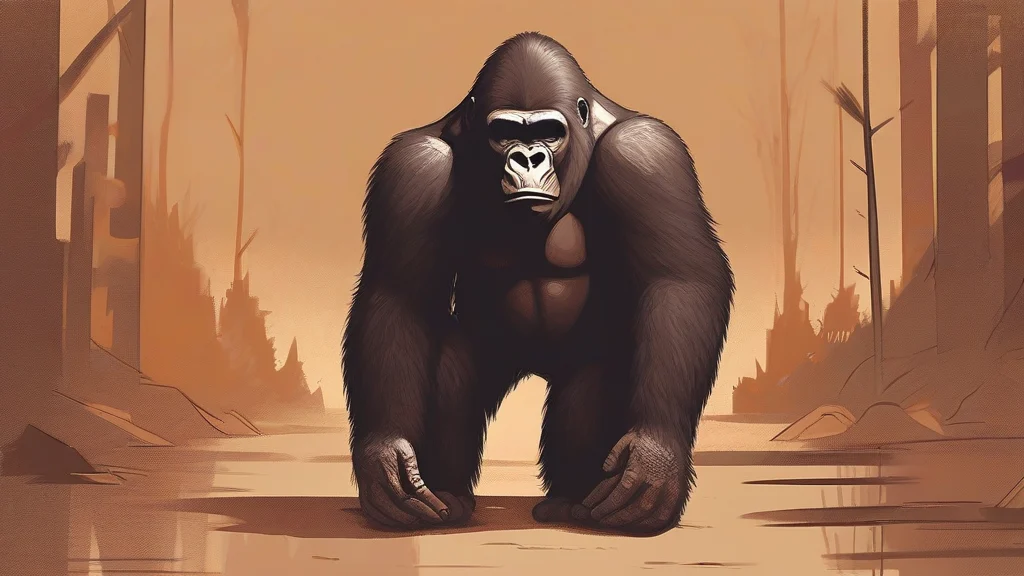
What does gorilloid mean?
Gorilloid is a rare English adjective meaning “resembling a gorilla.” It is most often encountered in zoology, anthropology, palaeontology, and other technical discussions of primate anatomy. The word describes visible or measurable similarities to a gorilla, such as the shape of the skull, the structure of the brow, broad bodily proportions, or other physical features; it does not necessarily indicate that the organism is a gorilla or even closely related to one. For example, an extinct ape might be described as having gorilloid features without being formally classified among the gorillas. The word is formed from “gorilla” and the widely used suffix “-oid,” which conveys resemblance or a characteristic form. Although gorilloid appears in specialised literature, it is unlikely to be encountered in ordinary conversation. Its usefulness lies in its precision: it labels a visual or anatomical resemblance without making the broader taxonomic claim that a simpler phrase such as “gorilla-like” might also make.
adjectiveResembling a gorilla, especially in physical form or anatomical features.
- Resembling a gorilla in appearance, bodily form, or anatomical characteristics.
"The fossil's heavy brow and broad chest gave it distinctly gorilloid features."
"The fossil's broad chest and heavy brow gave it distinctly gorilloid proportions."
"Researchers used the term gorilloid to describe the animal's skull morphology."
Gorilloid is a specialist's elegant shorthand for “gorilla-like”—a single word that packs both anatomy and resemblance into one description.
Reviewed by Deb Chak, Editor. AI-assisted content curated by RJS Tech Solutions LLP.
Where does gorilloid come from?
Gorilloid is an English formation built from “gorilla” and the Greek-derived suffix “-oid,” meaning “resembling” or “of the form of.” The suffix appears in many comparative anatomical and biological terms, including hominoid, humanoid, and ovoid. Related words such as gorilline, gorilliform, and the taxonomic name Gorillini were likewise formed from the same base, “gorilla.”
How gorilloid is actually used
This is a rare, chiefly zoological or anthropological adjective. It is descriptive and comparative rather than taxonomic, so it should not be treated as the formal name of a species or group.
Easily confused with gorilloid
A gorilla is a member of the great-ape genus Gorilla, whereas gorilloid is an adjective describing something that resembles a gorilla.