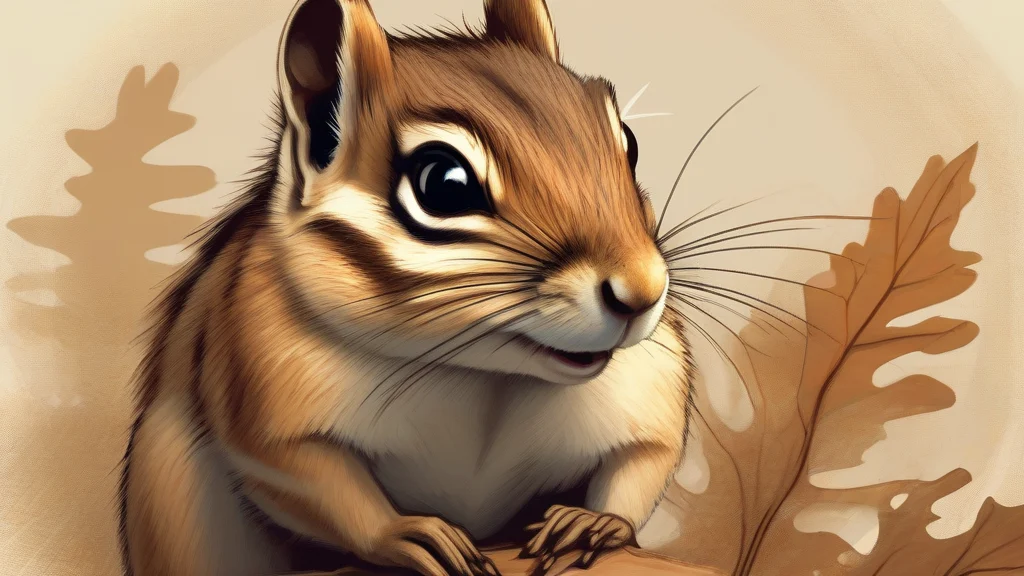
What does chipmunk mean?
A chipmunk is a small, quick-moving rodent native to North America and a member of the squirrel family, easily recognized by the alternating dark and light stripes running down its back and by its remarkable cheek pouches, which it uses to carry seeds, nuts, and berries back to its burrow. Unlike tree squirrels, chipmunks spend much of their time on the forest floor and store food in underground larders to survive the winter, though they do not truly hibernate and wake periodically to eat their stores. In everyday language the word carries a warm, endearing connotation, appearing frequently in nature writing, children's books, and cartoons. It has also given rise to the affectionate phrase 'chipmunk cheeks,' describing a face puffed out with food. Compact, charming, and instantly recognizable, 'chipmunk' is a vivid word that evokes woodland scenes and industrious little creatures gathering provisions for the cold months ahead.
nounA small, striped rodent of North America belonging to the squirrel family (Sciuridae) and especially the genus Tamias, having a bushy tail and expandable cheek pouches used for carrying food.
- A small striped North American rodent of the squirrel family, with cheek pouches for storing food.
"A chipmunk darted across the campsite with its cheeks bulging full of seeds."
"The children watched a chipmunk stuff acorns into its cheek pouches at the edge of the trail."
"He grinned until his face puffed out like a chipmunk hoarding for winter."
Regular plural formed by adding -s.
"Several chipmunks were busy collecting seeds beneath the bird feeder."
A chipmunk's stretchy cheek pouches can hold enough food to swell its head to nearly the size of its whole body.
Reviewed by Deb Chak, Editor. AI-assisted content curated by RJS Tech Solutions LLP.
Etymology of chipmunk
The word 'chipmunk' entered English in the early nineteenth century, borrowed from an Algonquian language of northeastern North America — commonly identified as Ojibwa — where related forms such as 'ajidamoon' refer to a red squirrel or similar striped rodent. Early American naturalists recorded several variant spellings before 'chipmunk' became standardized. As a borrowing from an Indigenous American language rather than from Latin or Greek, it has no European cognates.
How chipmunk is actually used
The word is informal-friendly and widely understood in both British and American English, though the animal itself is native only to North America. In casual speech, 'chipmunk cheeks' describes someone whose mouth is comically full or puffed out.
Easily confused with chipmunk
A chipmunk is a smaller ground-dwelling relative of the tree squirrel, marked by stripes down its back and cheek pouches, whereas most familiar squirrels are larger, lack these stripes, and live mainly in trees.