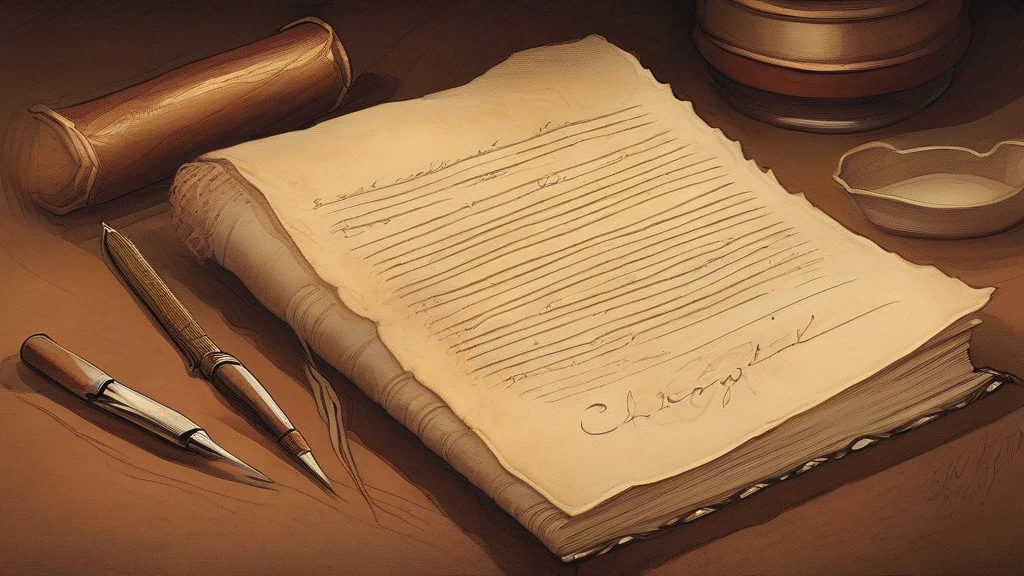
What does chirograph mean?
A chirograph is a document or piece of writing produced by hand, as opposed to something typed or printed. The term carries a formal, scholarly tone and appears most often in historical, archival, and legal discussions, where it may denote anything from a personal letter to a formal deed. In medieval Europe it had a precise technical meaning: a legal instrument written out twice on a single sheet of parchment, then cut apart along a wavy or indented line running through the text itself. Because no two cuts are identical, the matching edges allowed parties to authenticate their copies and guard against forgery — an early ancestor of modern anti-tampering measures. The word descends from Greek roots meaning 'hand' and 'to write', the same roots that give us chirography, the art of penmanship. Though rare in everyday speech, chirograph survives usefully in palaeography and legal history, where precision about handwritten records still matters.
nounA document or piece of writing made by hand; specifically, a written instrument or deed executed by hand, especially one signed as proof of an agreement.
- A document, writing, or signature produced by hand.
- A legal instrument or deed executed in duplicate, with copies separated by a distinctive cut through the text (historical).
"The medieval chirograph was drawn up in duplicate so that each party could verify the other's copy against the cut line."
"Each monk contributed his own chirograph to the abbey's record of the land grant."
"The archivists catalogued a twelfth-century chirograph bearing the wavy incision used to guard against forgery."
The regular English plural is standard; the Latinized form 'chirographa' is rare and confined to academic prose.
"The archive holds dozens of medieval chirographs from the region's monasteries."
Medieval scribes drew up contracts twice on one sheet of parchment and sliced between them with a wavy cut — matching the jagged edges proved neither copy had been forged.
Reviewed by Deb Chak, Editor. AI-assisted content curated by RJS Tech Solutions LLP.
Etymology of chirograph
Chirograph comes from Latin chirographum, borrowed from Greek kheirographon, a compound of kheir ('hand') and graphein ('to write'), literally 'that which is written by hand'. It entered English usage in the medieval period through legal and ecclesiastical Latin. The kheir root also yields English relatives such as chirography, chiropody, chiromancy, and chiropractic.
Related word forms
How chirograph is actually used
A formal, learned term now largely confined to historical, archival, and legal contexts; ordinary speakers would simply say 'handwriting' or 'manuscript'.
Easily confused with chirograph
Chirograph means the handwritten document or writing itself, whereas chirography refers to the art or practice of handwriting.