What does chirr mean?
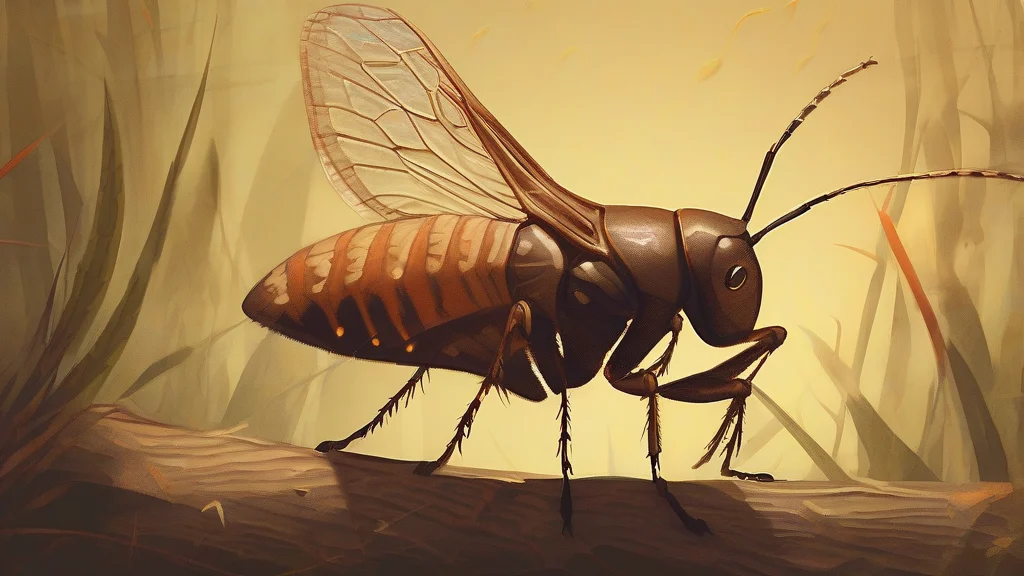
Chirr denotes a sustained, trilling, slightly rattling sound — most characteristically the song produced by grasshoppers, crickets, and cicadas as they rub their wings or legs together, a process known as stridulation. It can be used as a noun, naming the sound itself, or as a verb, describing the act of making it: a field may be full of the chirr of insects, or the insects may be said to chirr in the heat. The word is entirely onomatopoeic, coined in imitation of the sound it describes, and first appeared in English in the seventeenth century. Today it is a relatively rare word, found chiefly in nature writing and descriptive prose, where its evocative quality suits scenes of hot, drowsy summer afternoons filled with insect noise. Readers most often encounter it alongside near neighbours such as chirp and whirr, from which it is distinguished by its continuity — a chirr is not a brief note but a long, unbroken trill.
A prolonged trilling or rattling sound, especially that made by grasshoppers, crickets, or cicadas.
"The only sound was the steady chirr of cicadas in the olive trees."
Almost always encountered in descriptive or nature writing.
To make or emit a continuous trilling sound, as certain insects do.
"Crickets chirred in the warm darkness beyond the tent."
Conjugates as chirred and chirring.
Standard plural; used when referring to multiple instances of the sound.
"Different chirrs rose and fell across the meadow as night came on."
"Chirr" is pure onomatopoeia — English simply copied the summer insect's song straight into the dictionary.
Reviewed by Deb Chak, Editor. AI-assisted content curated by RJS Tech Solutions LLP.
Etymology of chirr
Chirr is an onomatopoeic formation, adopted into English in the seventeenth century in direct imitation of the trilling sound of insects. It belongs to a small family of imitative bird- and insect-call words, including chirp and chirm, which arose through similar mimicry rather than descent from a shared ancestral root. Because of its imitative origin, it has no true cognates in other languages, though comparable echoic words exist elsewhere.
How chirr is actually used
Chirr is uncommon and largely confined to descriptive nature writing; both the noun and the verb are used informally rather than in technical contexts. As a verb it is weakly conjugated (chirred, chirring).
Easily confused with chirr
A chirp is a short, sharp bird-like note, while a chirr is a continuous trilling or rattling sound, typically of insects.
A whirr is the rapid buzzing vibration of wings or machinery, whereas a chirr is the stridulating trill of insects such as grasshoppers.