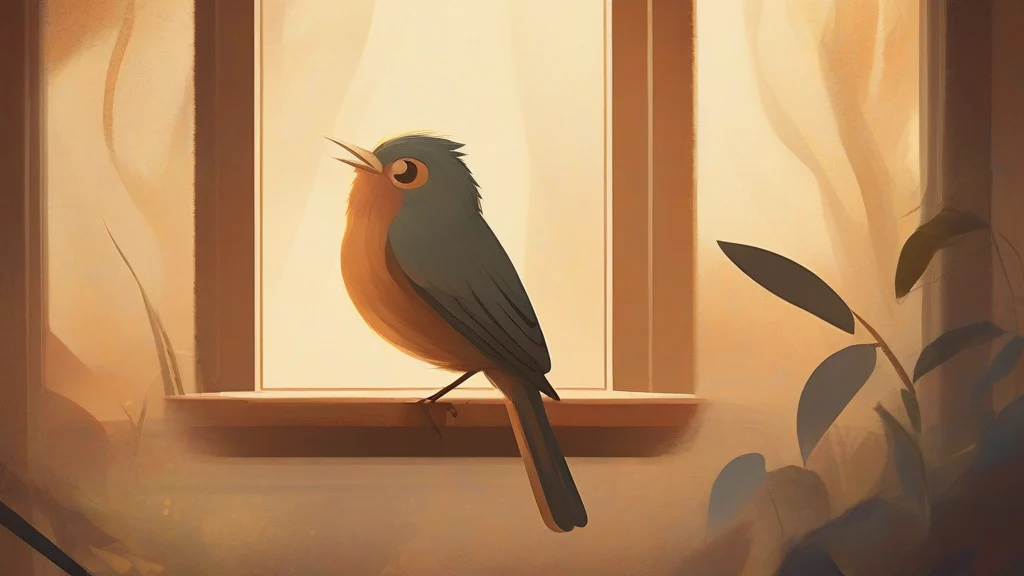
What does chirruping mean?
Chirruping is the present participle of the verb 'chirrup', meaning to produce a series of short, high-pitched, cheerful sounds. It is applied most naturally to small birds, crickets, and other creatures whose song comes in quick, bright bursts, and by extension to people who speak in a similarly light, lively manner — as when someone greets the morning with an energetic hello. The word carries an affectionate, pleasant connotation; there is nothing harsh about a chirrup. It belongs chiefly to informal and literary registers and appears somewhat more often in British English than American English, where 'chirping' is the everyday choice. Formed as an expressive, imitative word — one that echoes the very sound it describes — 'chirrup' emerged in English in the early modern period alongside its variant 'chirp'. Writers reach for 'chirruping' when they want a touch of warmth or old-fashioned charm: hedges full of chirruping sparrows, or a friend chirruping encouragement from across the room.
Present participle and gerund of 'chirrup': to make short, high-pitched, cheerful sounds, as small birds or crickets do.
"Wrens were chirruping busily among the brambles."
Also used figuratively of human speech that is bright and animated.
A series of short, high-pitched chirping sounds.
"The soft chirruping of crickets filled the summer evening."
That little '-rrup' makes all the difference: 'chirruping' is the same cheerful birdsong as 'chirping', just dressed in its older, more musical British clothes.
Reviewed by Deb Chak, Editor. AI-assisted content curated by RJS Tech Solutions LLP.
Etymology of chirruping
Chirruping derives from the verb 'chirrup', an expressive, onomatopoeic formation recorded in English from around the early seventeenth century. It arose as an altered or extended variant of the earlier 'chirp', both words imitating the short, sharp sounds of small birds. The same imitative impulse produced relatives such as 'twitter' and 'chatter', and the dialectal 'chirm'. The word has always carried a cheerful, bright connotation, which it retains today.
Related word forms
How chirruping is actually used
Somewhat informal-to-literary in register; the base verb 'chirrup' is commoner in British English than American English. Applied to people it is almost always affectionate or mildly humorous.
Easily confused with chirruping
'Chirping' is the standard, more common form of the sound-word, while 'chirruping' is a variant spelling/pronunciation of the same idea, often felt to be slightly more British or literary.