What does chlorite mean?
Chlorite is a noun with two distinct scientific meanings. In geology, it names a group of soft, green, flaky minerals belonging to the silicate family, typically produced when rocks such as basalt undergo low-grade metamorphism; the presence of chlorite gives rocks like slate and greenschist their characteristic greenish hue and is used by geologists as an indicator of the temperatures and pressures those rocks experienced. In chemistry, chlorite refers to any salt or ester of chlorous acid, containing the chlorite ion (ClO₂⁻); compounds such as sodium chlorite are valued industrially as bleaching agents and as precursors to chlorine dioxide, which disinfects drinking water. Both uses derive from the Greek word for pale green, reflecting the color of the mineral. The term belongs firmly to technical registers — field notebooks and laboratory reports — rather than casual speech, but it repays attention: few everyday nouns quietly span the disciplines of mountain-building geochemistry and modern water treatment.
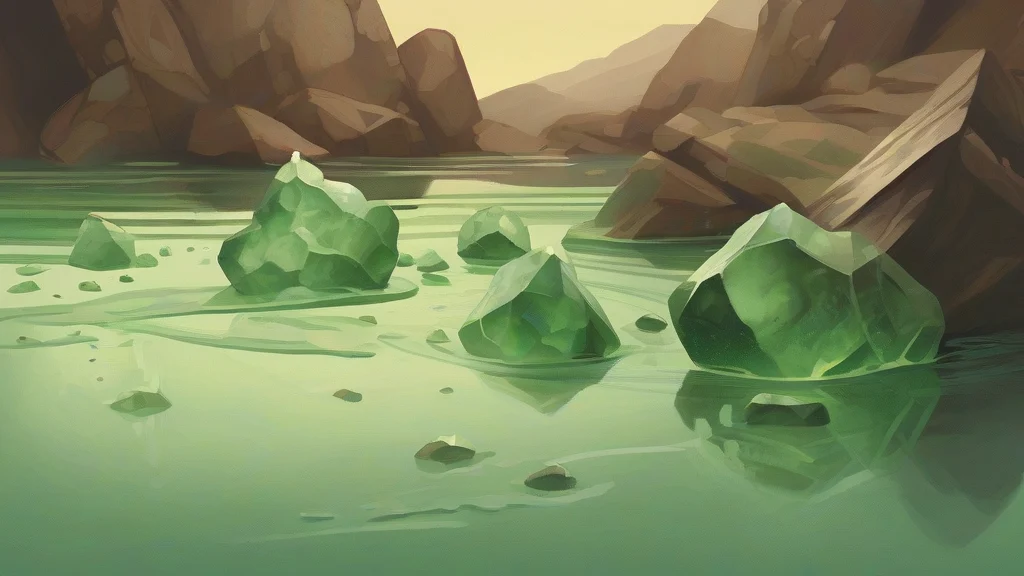
Any of a group of green, micaceous sheet silicate minerals, typically secondary in origin and characteristic of low-grade metamorphic rocks.
"Greenschist owes its name and color to the abundance of chlorite within it."
In geology, chlorite actually denotes a group of several closely related minerals rather than one single species.
A salt or ester of chlorous acid, containing the univalent anion ClO₂⁻.
"Sodium chlorite serves as a source of chlorine dioxide in industrial bleaching and water treatment."
Pluralized when referring to multiple specimens, varieties, or members of the mineral group; as a mass noun for the material, it often remains singular.
"Thin sections of the schist revealed several distinct chlorites intergrown with quartz."
Chlorite is two words wearing one name: a green rock-forming mineral under geologists' feet and a bleach-forming industrial ion in water treatment plants.
Reviewed by Deb Chak, Editor. AI-assisted content curated by RJS Tech Solutions LLP.
Etymology of chlorite
The word chlorite entered English in the late 18th century, coined from the Greek 'chlōros,' meaning pale green or yellowish-green — the same Greek root that gives us 'chlorine' and 'chlorophyll.' The German chemist and mineralogist who introduced it chose the name for the characteristic green color of the mineral. The chemical sense, naming salts of chlorous acid, followed later by analogy with related chlorine-oxygen compounds such as chloride and chlorate, so both meanings trace back to that single Greek root for green.
Related word forms
How chlorite is actually used
Both senses are technical terms used mainly in geology and chemistry; neither is common in everyday conversation. In scientific writing, context usually makes clear which sense is intended.
Easily confused with chlorite
A chloride is a compound of chlorine with a metal (such as sodium chloride), whereas chlorite is either a green sheet-silicate mineral or a chlorine oxyanion (ClO₂⁻) — different substances entirely.
Chlorine is the chemical element itself, while chlorite is a mineral named for its green color or an oxygen-bearing ion derived from chlorine.