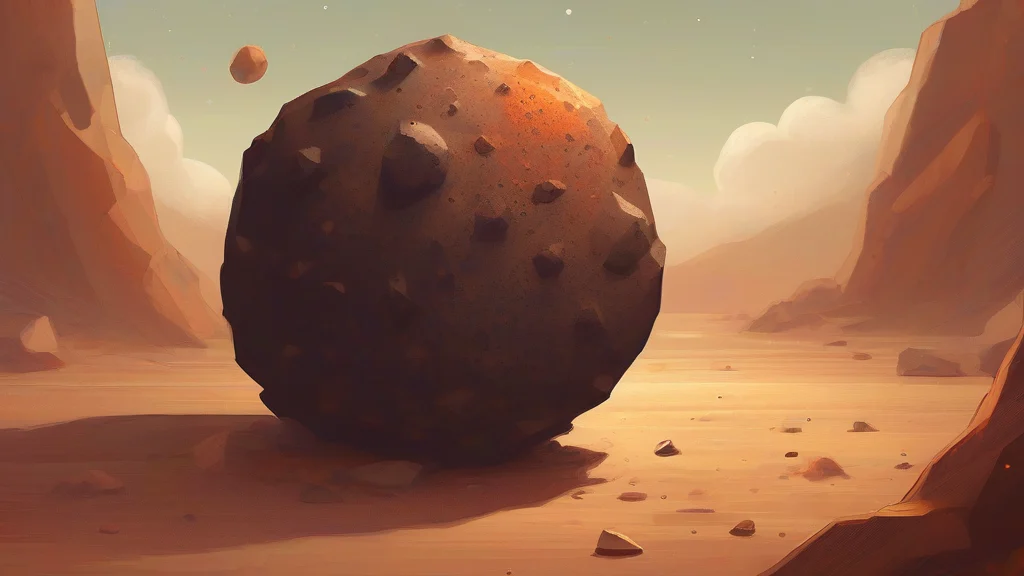
What does chondrite mean?
A chondrite is a type of stony meteorite distinguished by the presence of chondrules — tiny, round grains of silicate minerals that crystallized from molten droplets in the early solar system. Because chondrites were never subjected to the melting and chemical differentiation that shaped planets, they preserve a remarkably pristine record of the raw materials from which the Earth and its neighbors formed, with some specimens dating back roughly 4.6 billion years. Scientists subdivide them into classes such as ordinary and carbonaceous chondrites, the latter being especially prized because they can contain water, organic compounds, and pre-solar grains. The word is technical, appearing chiefly in astronomy, geology, and meteoritics rather than casual speech, yet it carries a certain wonder: to hold a chondrite is to hold unaltered building blocks of the planets. Its adjective form is chondritic, and its diminutive relative is chondrule, the name for those characteristic embedded spheres.
nounA stony meteorite containing small spherical particles called chondrules, composed largely of silicate minerals; chondrites are among the oldest solid materials in the solar system.
- A stony meteorite characterized by the presence of chondrules, formed from primitive solar-system material that was never melted into a planet.
"The museum's newest acquisition is a chondrite that fell over the Sahara more than a century ago."
"The carbonaceous chondrite recovered from Antarctica contained amino acids formed in interstellar space."
"Scientists classify a chondrite by its chemical composition and the degree to which its chondrules have been altered."
Regular plural; commonly used when discussing falls, finds, or classifications of multiple specimens.
"Carbonaceous chondrites are among the most scientifically valuable meteorites ever recovered."
Cut open a chondrite and you're looking at grains older than the Earth itself — leftovers from the solar system's construction site, some nearly 4.6 billion years old.
Reviewed by Deb Chak, Editor. AI-assisted content curated by RJS Tech Solutions LLP.
Etymology of chondrite
The word 'chondrite' derives ultimately from the Greek 'chondros', meaning grain or cartilage, adopted in the nineteenth century by meteorite researchers to describe stony meteorites studded with granular inclusions. The related term 'chondrule' was coined for the small rounded particles themselves. The same Greek root survives in scientific vocabulary such as 'hypochondria' (literally 'beneath the cartilage' of the ribs) and in anatomical terms like 'chondrocyte', a cartilage cell.
Related word forms
How chondrite is actually used
A technical term used mainly in planetary science, geology, and meteoritics; rare in everyday conversation. It appears frequently in scientific literature and in reporting on meteorite finds.
Easily confused with chondrite
An achondrite is a stony meteorite that lacks chondrules, having instead been melted and differentiated, whereas a chondrite retains its primitive chondrules.