
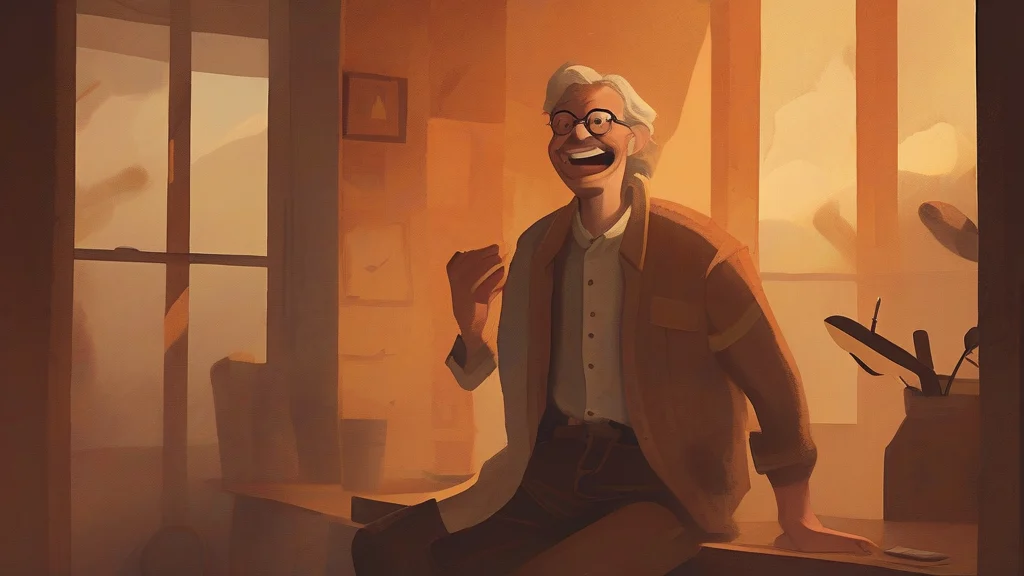
What does chortler mean?
A chortler is someone who chortles: a person whose laughter is sudden, loud, and full of unrestrained delight. The term is playful and evocative, suggesting not merely a quiet chuckle but a burst of amusement that may seem undignified, breathless, or even slightly ridiculous. It is related to the verb chortle, which Lewis Carroll introduced in Through the Looking-Glass in 1871 to name that distinctive kind of laugh. Chortler is therefore especially useful when the focus is on the person doing the laughing rather than on the laughter itself. The word is uncommon in everyday speech compared with chortle, but it has appeared in literary, descriptive, and humorous writing in both British and American English. Its whimsical sound and precise comic tone make it effective for depicting someone whose exuberance enlivens a room, a performance, or a narrative.
nounA person who chortles; someone who laughs loudly, explosively, and with evident delight.
- A person who laughs loudly and boisterously with delight.
"Her boisterous jokes made even the sternest chortler laugh."
"Her boisterous jokes made even the sternest chortler laugh."
"The narrator calls the eccentric professor a relentless chortler, whose laughter punctuates every lesson."
The standard plural is formed by adding -s.
"The audience was soon reduced to a group of delighted chortlers."
Lewis Carroll gave English a word for laughter so forceful it sounds like it might involve hiccups: chortle.
Reviewed by Deb Chak, Editor. AI-assisted content curated by RJS Tech Solutions LLP.
Where does chortler come from?
The word comes from the coined verb chortle, introduced by the English writer Lewis Carroll in Through the Looking-Glass in 1871. Carroll used it to portray a laugh that combines delight, surprise, and a sort of bodily upheaval, rather than merely amusement. The agent noun chortler was formed from that verb by the regular English suffix -er, meaning a person who performs the action.
Related word forms
How chortler is actually used
A literary, playful, and relatively uncommon word. It emphasizes the person rather than the act of laughing and often carries a humorous or gently comic connotation.
Easily confused with chortler
A chortler is the person doing the laughing, whereas a chortle is the act of laughing in this boisterous, delighted way.