
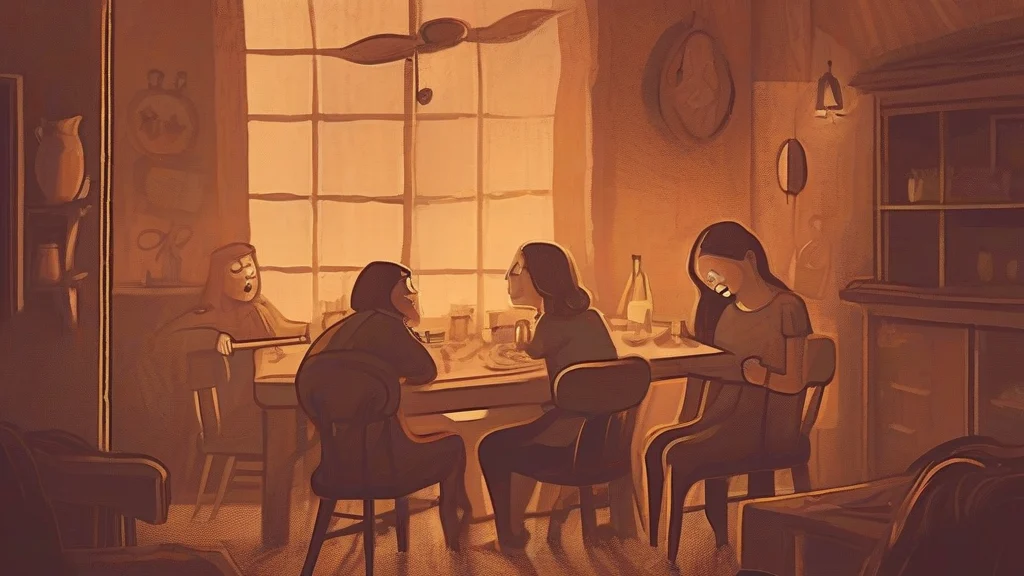
What does chortling mean?
Chortling is the present participle of "chortle," meaning to laugh with loud, gleeful satisfaction — a sound somewhere between a chuckle and a snort. Unlike a giggle, which is light and often nervous, or a guffaw, which is a sudden explosive burst, a chortle is sustained and self-satisfied, the laughter of someone thoroughly enjoying a joke, a mischief, or their own cleverness. The word is informal but widely understood on both sides of the Atlantic, and writers favour it because it paints character: a villain chortling over a scheme or a grandfather chortling at his own pun instantly conveys delight. Remarkably, the word has no ancient pedigree — Lewis Carroll coined "chortle" in Through the Looking-Glass (1871) by blending "chuckle" and "snort," and English speakers adopted it so enthusiastically that it now feels entirely natural.
Present participle of chortle: to laugh in a noisy, gleeful way that combines chuckling and snorting.
"The audience sat chortling throughout the comedian's set."
Almost always used with a connotation of warm amusement rather than scorn.
The action or sound of laughing in this gleeful, chuckling manner.
"A low chortling could be heard from behind the newspaper."
"Chortle" wasn't inherited from Old English or borrowed from Latin — Lewis Carroll invented it in 1871 by blending "chuckle" and "snort," and readers loved it into the language.
Reviewed by Deb Chak, Editor. AI-assisted content curated by RJS Tech Solutions LLP.
Etymology of chortling
Chortling derives from "chortle," a word invented by Lewis Carroll in his 1871 novel Through the Looking-Glass, where Humpty Dumpty explains it as a blend (or "portmanteau" word) combining "chuckle" and "snort." Readers found the coinage so apt that it escaped the page and entered ordinary English within decades. Because it is a modern invention rather than an inheritance from older languages, it has no true cognates, though its parent words "chuckle" and "snort" reflect the two sounds it was designed to fuse.
Related word forms
How chortling is actually used
Informal to neutral in register, chortling always carries a warm, amused connotation — it never suggests cruelty or mockery. It suits narrative prose well, evoking a picture of someone quietly delighted rather than roaring with laughter.
Easily confused with chortling
A chuckle is a soft, subdued laugh, while a chortle is louder and more exuberant, with an audible snorting or breathy burst of glee.