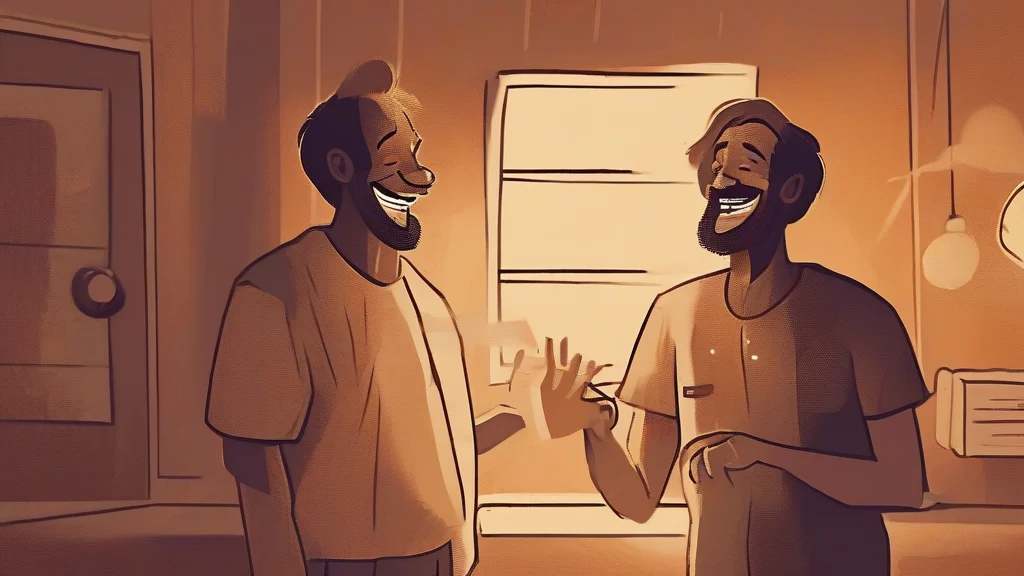
What does chuckling mean?
"Chuckling" is the present participle of "chuckle," a verb meaning to laugh quietly, softly, or inwardly. Unlike a guffaw or belly laugh, a chuckle is subdued — often little more than a low rumble of amusement — and it frequently signals that someone is privately entertained, whether by a witty remark, an absurd situation, or their own secret satisfaction. The word carries warm, benign connotations: chuckling suggests gentle humor rather than ridicule or hysteria, which is why writers so often use it to portray amiable, contented, or mischievous characters. It appears most commonly in continuous forms such as "was chuckling" or in constructions like "chuckling to himself." Interestingly, the underlying noun "chuckle" did not originally refer to laughter at all; in sixteenth-century English it described the clucking of a hen, and only later came to denote a quiet human laugh. Today "chuckling" remains a familiar and useful way of describing understated, good-humored laughter.
verbChuckling is the present participle of the verb chuckle: to laugh quietly or inwardly, often in amusement, satisfaction, or at one's own private joke.
- To laugh quietly or inwardly, especially in amusement, self-satisfaction, or at a private joke.
- (As a gerund/present participle) functioning as the ongoing form describing that act of quiet laughing.
"He kept chuckling to himself as he read the comic strip."
"She was still chuckling about the mix-up hours later."
"The old man sat by the fire, chuckling gently at some long-remembered jest."
"Chuckle" didn't start as laughter at all — it originally meant the clucking sound of a brooding hen before English speakers borrowed it for quiet human amusement.
Reviewed by Deb Chak, Editor. AI-assisted content curated by RJS Tech Solutions LLP.
Etymology of chuckling
"Chuckle" arose in late sixteenth-century England, where it originally denoted the clucking or gurgling sound made by a brooding hen — a word rooted in the older imitative term "chuck," meaning a cluck. Over the course of the seventeenth century its meaning shifted from the bird's sound to a quiet, suppressed human laugh, likely because the two were acoustically similar. The word belongs to a family of laugh-related terms including "chortle," which Lewis Carroll famously coined in the nineteenth century as a blend of chuckle and snort.
Related word forms
How chuckling is actually used
Chuckling connotes mild, good-natured, often private amusement rather than loud laughter. It is common in both casual and literary prose and frequently appears in descriptions of characters quietly amused by their own thoughts. The phrase "chuckling to oneself" emphasizes that the amusement is not fully shared.
Easily confused with chuckling
Cackling is a loud, harsh, raucous laugh (like a hen's cry), whereas chuckling is a soft, quiet, often suppressed laugh.