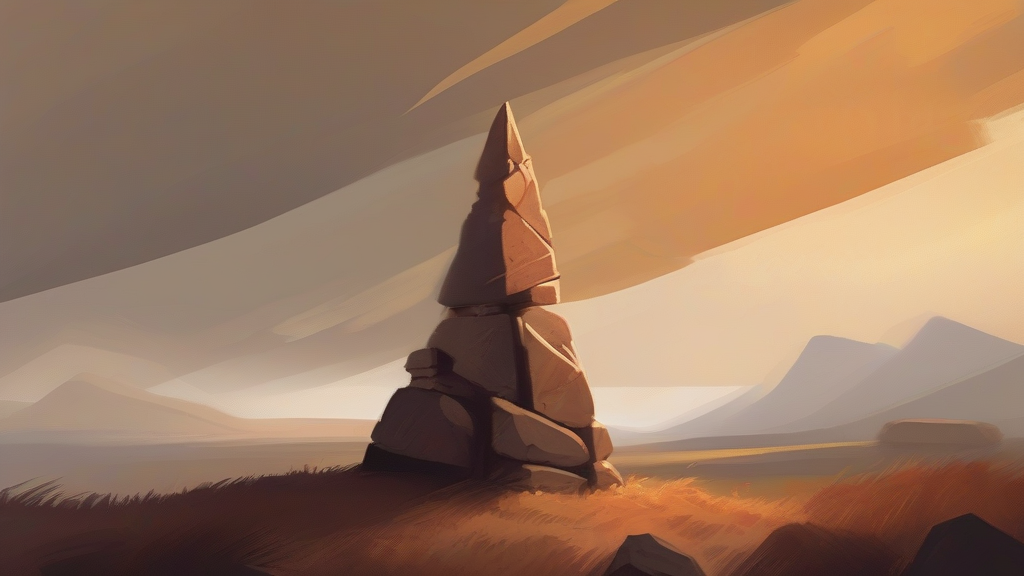
What does clach mean?
Clach is a Scottish word for a stone, entering Scots and Highland English directly from Scottish Gaelic, where the equivalent term remains in everyday use. In practice it most often denotes a sizeable stone — a boulder or rock rather than a mere pebble — and it appears both in rural speech and in the landscape itself, since numerous Highland placenames preserve the element in forms like clachan (a village or, originally, a cluster of stones) and similar constructions. For English speakers, clach carries strong regional connotations: using it signals a connection to Gaelic culture, crofting country, or the rugged terrain of northern Scotland. It rhymes naturally with other Gaelic loanwords such as loch and broch, which share its distinctive final consonant sound in careful pronunciation. Though rare in standard modern English, the word is valued by writers seeking authentic local colour, and its survival illustrates how Gaelic vocabulary has quietly shaped Scots dialect and the naming of the Scottish landscape.
nounA stone, especially a large stone or boulder; a word of Scottish Gaelic origin used chiefly in Scots and Highland English.
- A stone or rock, especially a large one; used in Scots and Highland English.
- (In Gaelic placenames) a stone or rocky feature, as in names such as Clachan or Clach Dubh.
"The crofter cleared every clach from the field before the first ploughing."
"He stumbled over a moss-covered clach on the path down to the loch."
"The old boundary was marked by a standing clach that locals had never dared move."
The regular English plural is standard; Gaelic plural forms are not used in English contexts.
"The burn tumbled over grey clachs worn smooth by centuries of water."
Before it was ever an English word, clach was simply what Gaelic speakers called any stone — and it survives today in place names scattered across the Highlands.
Reviewed by Deb Chak, Editor. AI-assisted content curated by RJS Tech Solutions LLP.
Etymology of clach
Clach comes directly from Scottish Gaelic, in which the native word for a stone entered Scots and Highland English during the long contact between Gaelic-speaking Highland communities and Scots speakers. Its Gaelic counterpart is cognate with Old Irish cloch, reflecting the shared heritage of the Goidelic languages, and related Irish forms include clochan, a term for stepping-stones or a stone causeway that also gave rise to the sense 'village' in Irish placenames. The word has remained chiefly regional, never spreading far beyond Scotland's Gaelic-influenced areas.
How clach is actually used
The word is regional and somewhat literary or dialectal; outside Scotland it is likely to be unfamiliar even to educated readers, so it is best used where a Scottish flavour is intentional.
Easily confused with clach
"Clack" is an English noun and verb meaning a sharp rattling sound or the act of making one, whereas "clach" is a Scottish word meaning a stone.