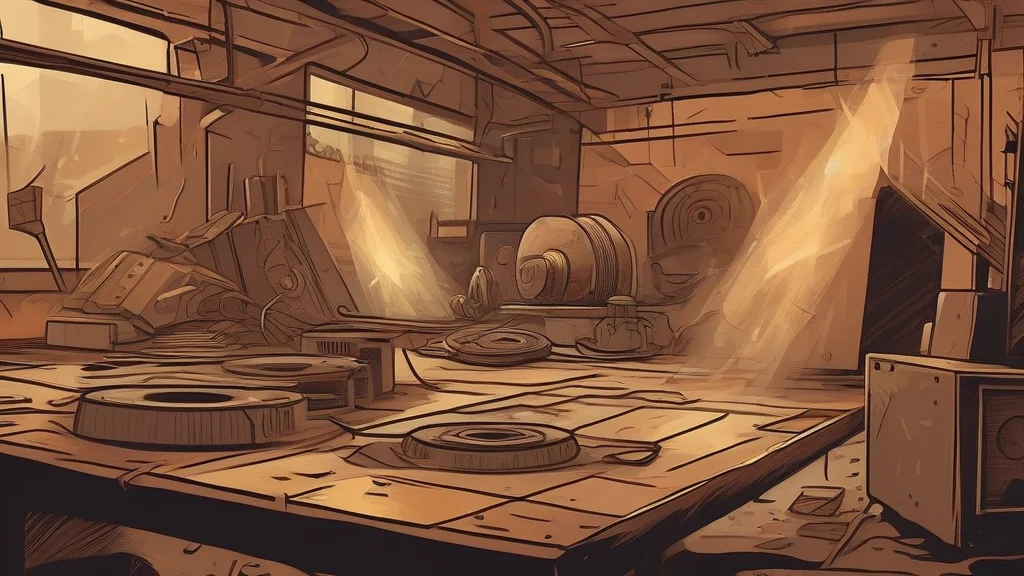
What does clanking mean?
Clanking is the present participle of the verb 'to clank', describing the making of a loud, harsh, metallic ringing sound — the kind produced by heavy pieces of metal striking one another. The word is thoroughly onomatopoeic in character: its very form echoes the noise it denotes, much like related echoic words such as 'clang' and 'clink'. Clanking appears most often in descriptive writing and everyday speech when evoking industrial machinery, steam engines, suits of armor, prison chains, or aging radiators and pipes. Its connotations lean toward weight, wear, and sometimes menace or gloom, which makes it a favorite of novelists and journalists seeking atmosphere. It can also function as a noun, referring to the sound itself, as in 'the clanking of the factory floor'. Distinguished from the lighter 'clink' and the more sustained 'clang', clanking specifically suggests repeated, heavy metallic impact, giving writers a precise tool for rendering one of the most evocative noises in the world of objects.
To make a loud, harsh, metallic ringing sound, especially through the collision or movement of heavy metal objects.
"The chain-link gate kept clanking in the wind all night."
Almost always used with physical metal sources; figurative use is rare.
A loud, resonant metallic clatter; the sound made by something that clanks.
"He woke to the rhythmic clanking of the mill across the valley."
Rarely pluralized; the noun sense is usually treated as an uncountable or singular mass reference to the sound.
"The various clankings and hissings of the old boiler filled the basement."
Before anyone wrote the word down, 'clank' was pure onomatopoeia — English simply copied the sound of metal hitting metal and gave it letters.
Reviewed by Deb Chak, Editor. AI-assisted content curated by RJS Tech Solutions LLP.
Etymology of clanking
The verb 'clank' is an onomatopoeic formation, imitating the sound of heavy metal striking metal, and entered written English around the early modern period. It likely arose from or alongside related echoic forms in Germanic languages, including Middle Dutch and Middle Low German 'klank' (sound, ring), which share the same imitative impulse. Its close relatives in English include 'clang' and 'clink', each capturing a different pitch and weight of metallic noise. Because these words were coined from sound rather than derived from classical roots, they lack Latin or Greek cognates, but they belong to a family of expressive Germanic formations that reproduce acoustic experience directly in language.
Related word forms
How clanking is actually used
Primarily used in vivid, descriptive, or literary contexts to evoke industrial settings, medieval armor, chains, or aging machinery. The word carries strongly auditory and often atmospheric connotations, suggesting heaviness, age, or disrepair rather than precision.
Easily confused with clanking
'Clinking' refers to a lighter, higher-pitched metallic sound, such as glasses touching, whereas 'clanking' describes a heavier, louder, more resonant metallic noise.
'Clangor' is a noun denoting a continuous, resounding metallic din, while 'clanking' describes the repeated action or individual sounds of heavy metal striking.