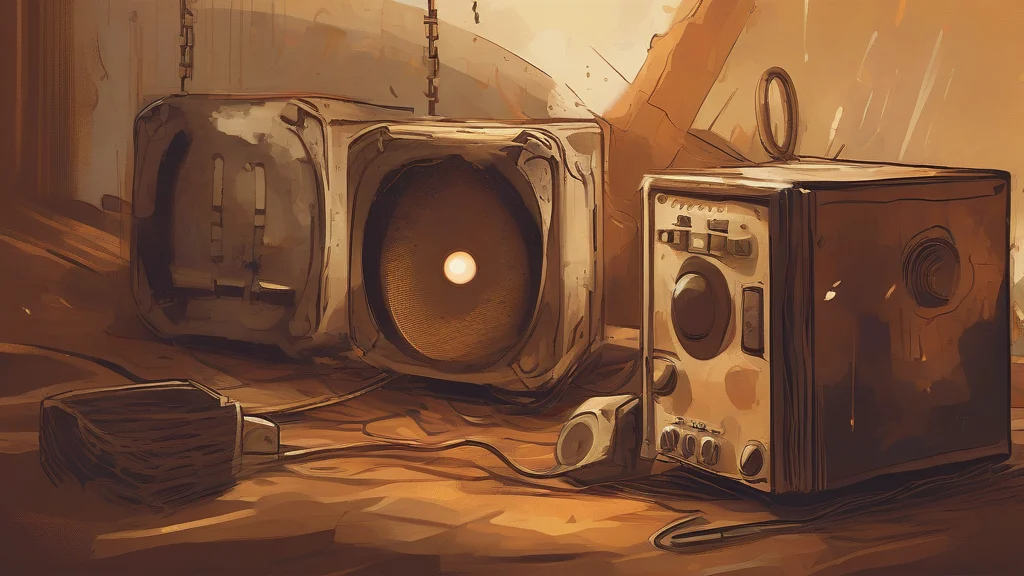
What does clank mean?
Clank refers to a sharp, ringing metallic sound — the noise made when heavy pieces of metal strike one another, such as chains dragging across a floor, a dropped wrench, or a suit of armor in motion. It functions as both a noun ("the clank of the gate") and a verb ("the gate clanked shut"). The word is distinctly onomatopoeic: its hard consonants mimic the very sound it describes, which makes it vivid and immediately evocative in writing. Clank carries connotations of weight, age, and mechanical clumsiness; it suits industrial settings, old machinery, armor, and plumbing far better than delicate or refined contexts. Writers often choose it over near-synonyms like clang or clatter when they want a heavier, duller resonance than clang's bell-like ring but more metallic bite than clatter's loose rattle. Its sensory precision has also earned it a place in comic books and film, where robots and machines are routinely given names playing on the sound.
A loud, ringing metallic sound, especially one produced by heavy metal objects striking together.
"The clank of the anchor chain echoed across the harbor."
Almost always used with "of" followed by the source of the sound.
To make a loud, ringing metallic sound, or to cause metal objects to do so by moving or striking them.
"The truck clanked over the rusty bridge grating."
Both intransitive use ("it clanked") and transitive-like use with an object ("she clanked the keys down") are common.
As a noun, clank takes a regular plural; however, it is most often used as an uncountable mass noun referring to the sound itself.
"Distant clanks drifted up from the shipyard below."
Clank is one of those rare words that sounds exactly like what it means — say it once and you can practically hear a suit of armor falling down the stairs.
Reviewed by Deb Chak, Editor. AI-assisted content curated by RJS Tech Solutions LLP.
Etymology of clank
Clank arose in English as an imitative formation, first appearing in the early seventeenth century. It belongs to a family of similar-sounding words that echo metallic noises — including clang, clink, and clash — most of which emerged around the same period as writers sought vivid ways to render mechanical sounds in print. These words are generally considered independent imitative coinages rather than borrowings from another language, though they parallel similar formations in Germanic languages. The verb form developed alongside the noun, both sharing the same sound-symbolic origin.
Related word forms
How clank is actually used
Clank is onomatopoeic and informal-to-neutral in register; it appears frequently in both everyday description and fiction. It typically connotes something old, heavy, mechanical, or cumbersome rather than sleek or refined.
Easily confused with clank
"Clang" denotes a resonant, ringing metallic sound (like a struck bell), while "clank" is a duller, heavier metallic sound, like loose metal pieces knocking together.
"Clunk" is a dull, non-metallic thud, whereas "clank" specifically implies the ringing quality of metal striking metal.