What does clarence mean?
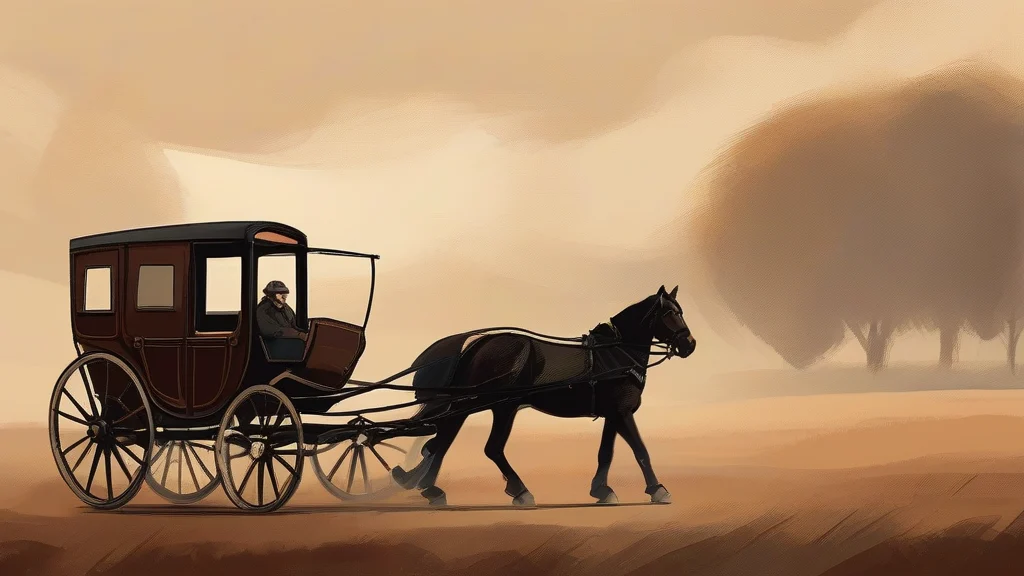
A clarence is a closed, four-wheeled horse-drawn carriage that flourished in nineteenth-century Britain. Designed to seat four passengers comfortably inside, it was usually drawn by a pair of horses and became one of the standard vehicles for private families and for hire in towns and cities. The name is said to honour the Duke of Clarence, whose title was borne by Prince William, later King William IV, giving the carriage a distinctly aristocratic association. Today the word survives chiefly as a historical term, appearing in accounts of Victorian life, period novels, and museum collections of coaching stock. For readers, 'clarence' offers a small window into pre-automobile travel, when distinctions among broughams, landaus, barouches, and clarences signalled wealth, status, and occasion on the streets of London and other British cities.
nounA clarence is a closed four-wheeled horse-drawn carriage, popular in 19th-century Britain, seating four passengers inside and typically drawn by two horses.
- A closed four-wheeled horse-drawn carriage of 19th-century Britain, seating four passengers inside.
"The bride arrived at the church in an elegant clarence drawn by a pair of greys."
"By mid-century, the clarence had become the standard hired carriage for respectable families in London."
"The museum's restored clarence still bears its original painted panels and leather upholstery."
Standard pluralization; used when referring to multiple such carriages, e.g. in fleet or hire-company contexts.
"The livery stable kept six clarences ready for wedding season."
The clarence was named after a royal duke who later became King William IV — a whole class of carriages took its name from his title.
Reviewed by Deb Chak, Editor. AI-assisted content curated by RJS Tech Solutions LLP.
Etymology of clarence
The clarence takes its name from the title Duke of Clarence, borne by Prince William Henry, who reigned as William IV from 1830 to 1837; the carriage style emerged in Britain around the early decades of the nineteenth century. The ducal title itself has a long history in the English peerage, associated historically with figures such as Lionel of Antwerp in the fourteenth century. The word is thus an eponym rather than deriving from any Latin or Greek root, and it has no cognates in other languages beyond borrowed forms of the same carriage name.
How clarence is actually used
A purely historical term: the clarence is encountered today almost exclusively in discussions of Victorian transport, period fiction, and carriage museums. It is always a noun and is now rare enough that many dictionaries list it only as an archaic or obsolete entry.
Easily confused with clarence
"Clearance" is the act of clearing or the space allowed between objects, while "clarence" is a historical type of horse-drawn carriage.