What does barouche mean?
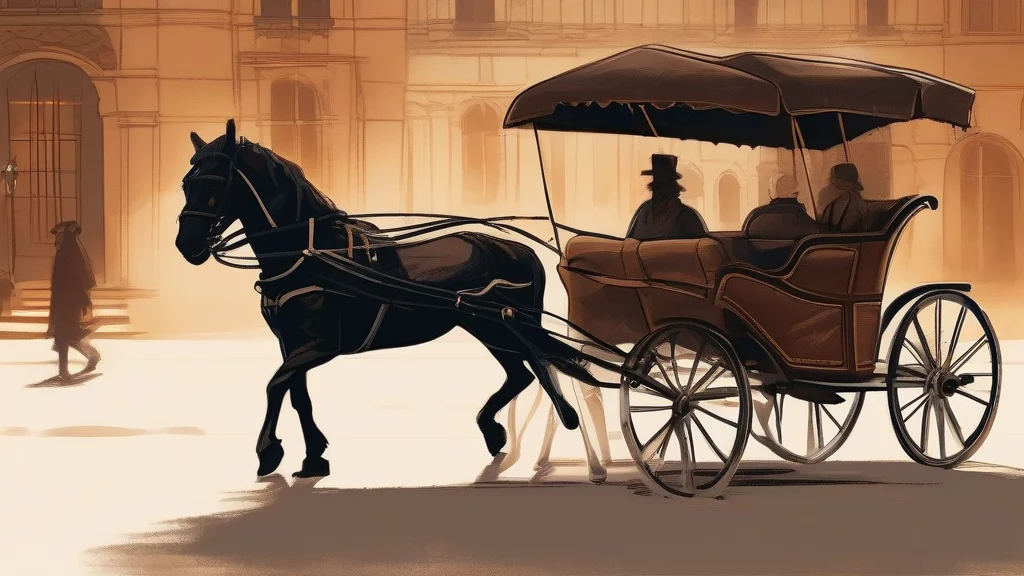
A barouche is a four-wheeled, horse-drawn carriage that flourished in the nineteenth century, especially among the fashionable classes of Britain and America. It is distinguished by its seating arrangement: two double seats facing one another, with a folding hood or calash that could be raised to shelter the rear passengers while those in front sat in the open air. Drawn by a pair of horses, it was a vehicle of some elegance and expense, often associated with leisurely drives in parks and promenades rather than practical travel. The word derives from the Italian 'baroccio', ultimately linked to the same root as 'baroque'. Today the term survives mainly in historical fiction and period drama, where it evokes the genteel world of Jane Austen and Charles Dickens.
nounA four-wheeled horse-drawn carriage with a collapsible hood over the rear seats and two facing benches, popular in the 19th century.
- A four-wheeled horse-drawn carriage with a folding hood over the rear seats and two facing benches.
"The barouche rolled up to the manor gates just as the church bells began to ring."
"A handsome barouche stood waiting at the hotel entrance."
"She rode through the park in an open barouche, waving to acquaintances along the row."
Standard plural form; used when referring to multiple carriages, e.g. in descriptions of coaching inns or traffic scenes.
"Half a dozen barouches were drawn up outside the assembly rooms."
The word 'barouche' comes from the Italian 'baroccio' — the same root that gave us 'baroque'.
Reviewed by Deb Chak, Editor. AI-assisted content curated by RJS Tech Solutions LLP.
Etymology of barouche
The word 'barouche' entered English in the early eighteenth century from the Italian 'baroccio', a light carriage, which itself traces back through German 'Barutsche'. The Italian term is related to 'baroco', the root of the word 'baroque', giving the carriage an unexpected linguistic kinship with the ornate artistic style.
How barouche is actually used
Now almost entirely historical; found chiefly in literature of the 19th century, particularly in the works of Dickens and Austen.
Easily confused with barouche
A landau has hoods over both front and rear seats that can meet in the middle, while a barouche has a single folding hood covering only the rear seats.