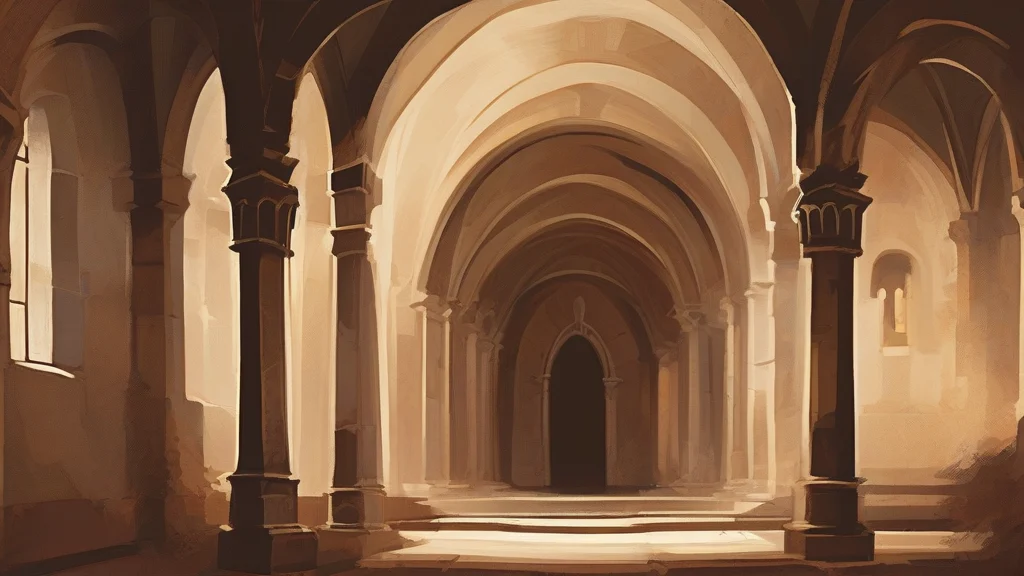
What does claustral mean?
"Claustral" is an adjective describing anything connected with a cloister or monastery, or evocative of the secluded, enclosed character of monastic life. In architectural and historical writing it often describes the buildings and layout of religious communities — a cathedral's claustral ranges, for instance — while in broader literary usage it conveys a sense of quiet withdrawal, confinement, or insulation from the outside world. The word derives from the Latin "claustrum," meaning an enclosed place or barrier, the same root that produced "cloister." A second, highly specialized sense appears in neuroscience, where "claustral" refers to the claustrum, a thin sheet of gray matter deep in the brain whose function remains an active subject of research. Formal and somewhat rare in everyday speech, "claustral" lends precision and atmosphere to writing about monasteries, academic quadrangles, or any setting marked by deliberate seclusion, making it a valuable word for readers of history, architecture, and literature alike.
Of or relating to a cloister or monastery; having the secluded or enclosed character of monastic life.
"The abbey's claustral buildings enclosed a peaceful central garth."
Most commonly used in architectural history and religious contexts.
(Anatomy) Of or relating to the claustrum, a thin lamina of gray matter situated deep in the brain between the insula and the lentiform nucleus.
"Studies have mapped extensive claustral connectivity with the prefrontal cortex."
Restricted to technical neuroscience usage.
The same Latin word for a locked enclosure gave us both "claustral," describing monastery life, and the name of a mysterious hidden layer of the brain that some scientists suspect helps bind consciousness together.
Reviewed by Deb Chak, Editor. AI-assisted content curated by RJS Tech Solutions LLP.
Etymology of claustral
"Claustral" comes from the Latin "claustrum," meaning a bar, bolt, or enclosed space, which itself derives from the verb "claudere," to shut or close. The word entered English through medieval ecclesiastical Latin, where "claustrum" named the enclosed precincts of a monastery, and English adopted "claustral" to describe matters pertaining to such enclosures. It shares its root with "cloister" and "enclose," and its cognates appear across the Romance languages in words for cloisters and enclosures. Its anatomical use arose later, when early modern anatomists applied the Latin term to the thin, enclosed-looking layer of neurons they observed in the brain.
How claustral is actually used
Formal in register and most often encountered in architectural history, religious writing, and literary description, where it connotes quietude, enclosure, and withdrawal from worldly affairs. The anatomical sense appears almost exclusively in neuroscience literature. A rare variant spelling "cloistral" exists but is much less common.
Easily confused with claustral
"Cloistral" is a rarer variant meaning essentially the same thing (relating to a cloister), while "claustral" is the more standard form and also has an anatomical sense relating to the claustrum of the brain.
"Claustrum" is a noun denoting either the enclosed part of a monastery or a thin sheet of neurons deep in the brain, whereas "claustral" is the adjective describing things related to it.