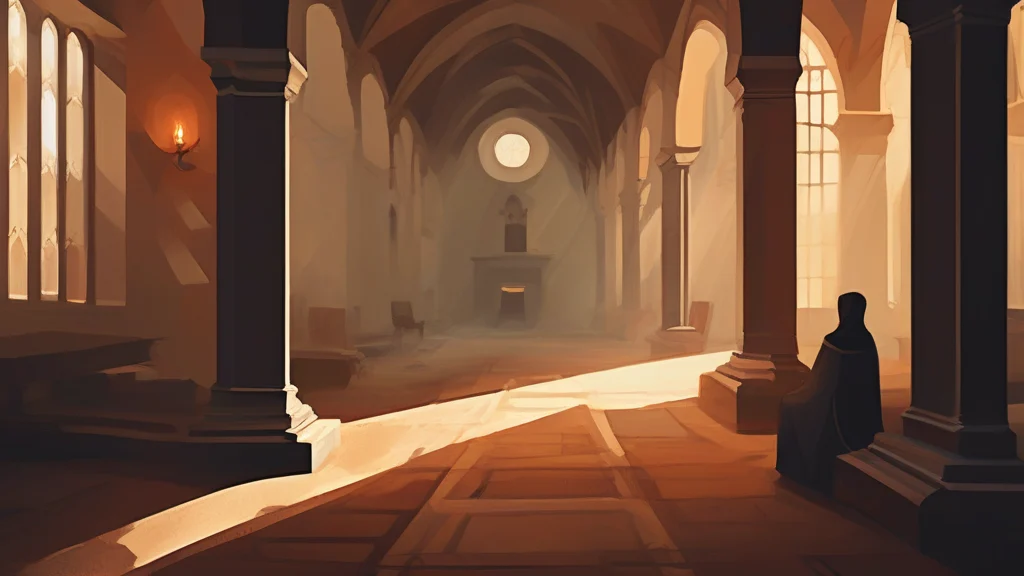
What does cloistered mean?
"Cloistered" is an adjective describing a state of seclusion — protected, sheltered, and cut off from the noise and dangers of ordinary life. The word derives from "cloister," the covered walkway surrounding a monastery courtyard, so it originally evoked the walled-in world of monks and nuns. Today it applies more broadly: one might speak of a cloistered upbringing, a cloistered academic environment, or a cloistered corner of a house. Because it suggests insulation from worldly experience, the word often carries a subtle connotation of innocence or naivety — a cloistered person may be imagined as untested by the rougher realities of life — though it can equally convey peaceful refuge or deliberate withdrawal. It remains chiefly a literary and formal word, valued for the vivid image of enclosure it conjures, whether literal (a cloistered garden) or figurative (a cloistered existence).
Secluded from the outside world; sheltered and protected from its activity or influences.
"She grew up in a cloistered valley where few outsiders ever ventured."
Often implies limited exposure to practical realities, especially when describing a person's upbringing.
Characteristic of or belonging to monastic seclusion.
"The abbey's cloistered corridors opened onto a silent garden."
'Cloistered' literally means 'walled in' — it comes from the same Latin root, claudere ('to close'), that gives us 'claustrophobia.'
Reviewed by Deb Chak, Editor. AI-assisted content curated by RJS Tech Solutions LLP.
Etymology of cloistered
The adjective "cloistered" derives from "cloister," which entered Middle English in the medieval period via Old French "cloistre" and ultimately traces back to Latin "claustrum," meaning an enclosed place or barrier, formed on the verb "claudere," "to shut or close." That same Latin root underlies "claustrophobia" (fear of enclosed spaces) and, more distantly, words like "close" and "enclosure." The adjectival form arose naturally to describe anything resembling the seclusion of monastic life, and by the early modern period it was well established in English for both literal and figurative seclusion.
Related word forms
How cloistered is actually used
Mostly literary or formal in register. When applied to people, 'cloistered' often carries a faint suggestion of naivety or inexperience with the real world, though it can also imply deliberate, peaceful retreat. It is frequently used of upbringings, institutions, and academic or religious communities.
Easily confused with cloistered
A cloister is the covered walkway around a monastery courtyard (or the monastery itself), while cloistered is the adjective describing someone or something sheltered or secluded like such a place.