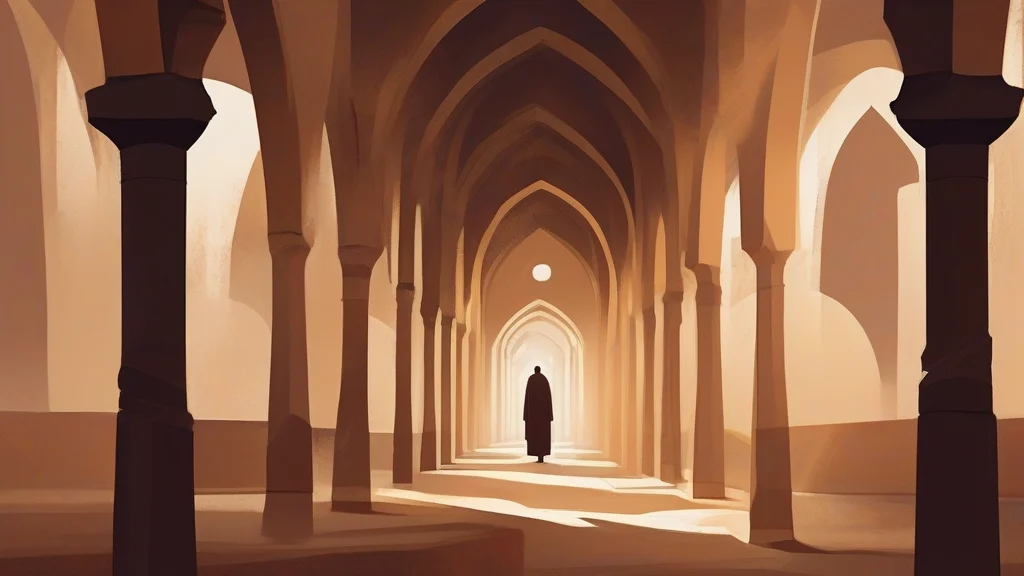
What does cloisterer mean?
A cloisterer is a person who dwells within a cloister — the enclosed precinct of a monastery or convent — and, by extension, anyone who leads a similarly sheltered or sequestered existence. In its primary sense the term applies to monks and nuns of contemplative orders whose lives unfold behind conventual walls, devoted to prayer, study, and work rather than engagement with secular society. Used figuratively, it describes someone kept apart from the bustle of the world, whether through deliberate choice of solitude or through circumstances that have shielded them from ordinary experience. The word derives from 'cloister', which traces back through Old French to the Latin claustrum, an enclosure. Though grammatically straightforward, 'cloisterer' is uncommon in modern English; writers typically prefer 'monastic', 'recluse', or 'hermit'. Its value lies in its precision: where 'recluse' suggests solitary withdrawal and 'monk' a specific vocation, 'cloisterer' evokes the enclosed communal life at the heart of the contemplative tradition.
nounA person who lives in a cloister, especially a monk or nun; more broadly, one who leads a secluded, sheltered life withdrawn from the world.
- A member of a religious community who lives enclosed within a monastery or convent.
- By extension, any person who lives a secluded or sheltered life, shut off from worldly affairs.
"After thirty years within the abbey walls, the elderly cloisterer had scarcely set foot beyond the gate."
"The medieval cloisterer spent his days in prayer, copying manuscripts by candlelight."
"Raised by protective parents in a remote valley, she grew up something of a cloisterer, meeting the outside world with wide-eyed wonder."
Standard regular plural; used when referring to multiple members of an enclosed community or several sheltered individuals.
"The storm sealed off the mountain pass, leaving the cloisterers to their winter of quiet devotion."
Rare enough to puzzle most dictionaries, 'cloisterer' names the person behind the arches — the monk or recluse the cloister was built for.
Reviewed by Deb Chak, Editor. AI-assisted content curated by RJS Tech Solutions LLP.
Etymology of cloisterer
Cloisterer is formed from 'cloister', which entered Middle English from Old French 'cloistre', itself derived from the Latin claustrum, meaning an enclosure or barred place, from the verb claudere, 'to close'. The suffix '-er' creates an agent noun denoting a person associated with the thing named. The word thus belongs to the same family as 'claustral' (relating to monastic enclosure) and 'claustration'; its use for enclosed religious and figuratively sheltered persons developed alongside the cloister's central role in medieval monasticism.
How cloisterer is actually used
The word is rare and somewhat literary; in everyday usage, 'monk', 'nun', or 'recluse' are far more common. When applied outside religious life it carries a mildly bookish, sometimes gently ironic tone.
Easily confused with cloisterer
A cloister is the covered walkway or monastic building itself, while a cloisterer is the person who lives or is confined within it.