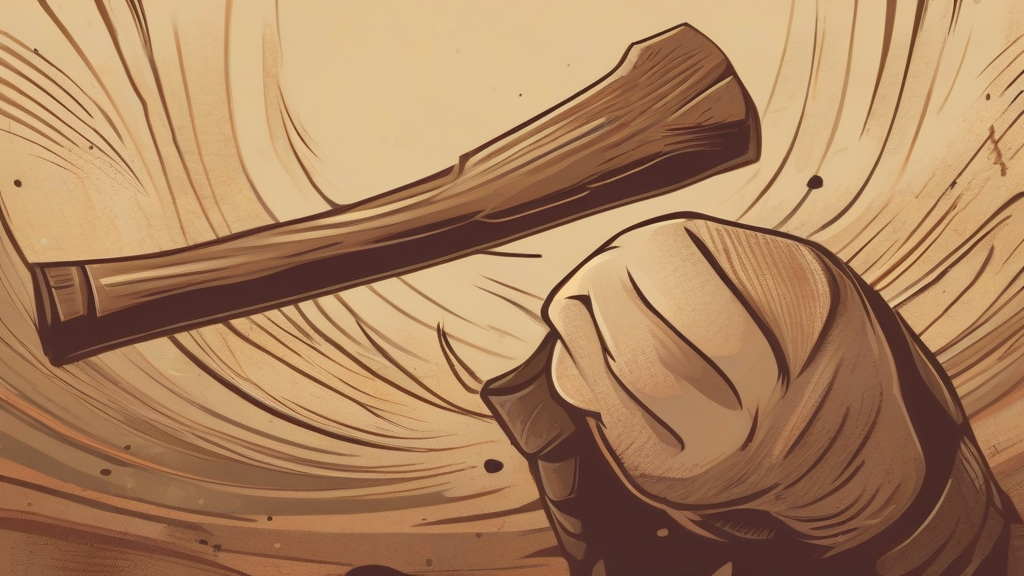
What does clawhammer mean?
A clawhammer is primarily a carpenter's hand tool: a light hammer whose steel head combines a flat striking face with a curved, cleft claw designed to grip and lever out nails. It is the standard all-purpose hammer of woodwork and household repair. The word has a second, quite different life in American folk music, where 'clawhammer' names a distinctive banjo-playing style — also called frailing — in which the player strikes the strings downward with the back of the fingernails while the thumb plucks the fifth-string drone, producing the driving, rhythmic sound associated with Appalachian old-time music. A third, largely historical sense refers to a formal tailcoat whose cutaway front resembles the curve of the tool's claw. In everyday use the term is concrete, practical, and unpretentious, evoking workbenches and jam sessions alike rather than any formal register.
A carpenter's hammer with a flat face for driving nails and a curved, split claw for extracting them.
"He loosened the rusted nail with a few taps before prying it free using his clawhammer."
Often written as two words ('claw hammer'); both spellings are accepted.
A syncopated, down-picking fingerstyle technique for playing the five-string banjo, characteristic of old-time Appalachian music.
"Her clawhammer playing gave the tune a rolling, hypnotic rhythm."
Usually encountered in the phrases 'clawhammer banjo' or 'clawhammer style'; closely related to the technique called frailing.
A man's tailcoat with a cutaway front, so named because its silhouette resembles the shape of a claw; now chiefly historical or formal-wear usage.
"The groom wore a black clawhammer with striped trousers for the evening ceremony."
Regular plural; used when referring to multiple tools or, less commonly, multiple coats.
"The hardware store stocked several different clawhammers on the wall display."
The same word names a nail-pulling carpenter's tool and one of the oldest, most driving styles of American banjo playing.
Reviewed by Deb Chak, Editor. AI-assisted content curated by RJS Tech Solutions LLP.
Etymology of clawhammer
Clawhammer is a straightforward English compound formed from the Old English noun 'claw' (the curved, pointed appendage) and 'hammer,' which derives from Proto-Germanic *hamaraz; its Germanic cognates include German 'Hammer' and Dutch 'hamer.' The compound arose in English by the seventeenth century to describe hammers whose cleft heads resemble an animal's claw. Its later musical sense developed in nineteenth-century America, named for the downward, raking motion of the picking hand.
Related word forms
How clawhammer is actually used
In woodworking and construction contexts, 'clawhammer' almost always refers to the tool; among folk musicians, it refers to the banjo technique, often heard in the fixed phrase 'clawhammer banjo.' The tailcoat sense is now largely historical or formal-wear terminology.
Easily confused with clawhammer
A ball-peen hammer has a rounded peen on its second face and is used for metalwork, whereas a clawhammer has a cleft claw specifically for extracting nails.
A sledgehammer is a heavy long-handled tool for delivering powerful blows, while a clawhammer is a light carpenter's tool designed for both driving and removing nails.