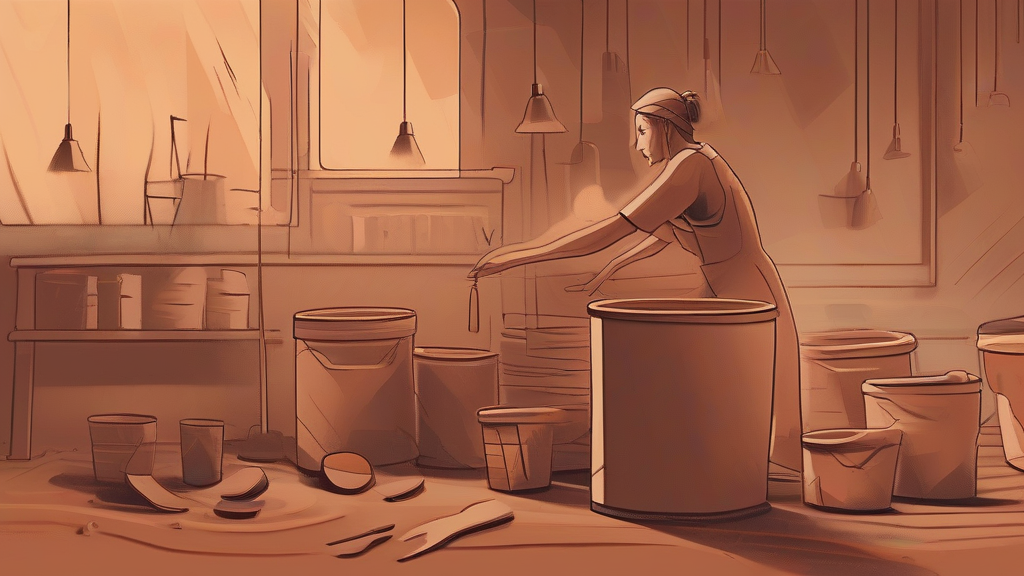
What does claying mean?
"Claying" is the present participle of the verb "to clay," meaning to cover, coat, or treat something with clay. The word appears chiefly in technical and historical contexts. In traditional sugar refining, claying was a crucial step: moist clay was packed over molded loaves of sugar so that it would gradually draw out residual molasses, leaving a whiter, purer product — a practice common from the seventeenth through the nineteenth centuries. The term also describes sealing or lining surfaces with clay, as in oven-building, well-lining, and certain pottery processes. Because it belongs largely to craft and industrial vocabulary, "claying" is uncommon in casual speech, but it remains useful for anyone reading about historical manufacturing methods or traditional building techniques. It should not be confused with "cloying," an unrelated adjective describing excessive sweetness or sentimentality.
verb (present participle/gerund)The present participle of the verb "clay": to cover, treat, or mix something with clay, especially in traditional processes such as refining sugar or working pottery.
- Covering or treating a surface or substance with clay.
- In historical sugar refining, purifying sugar by applying moist clay to draw out impurities.
- Working or shaping material in pottery or ceramics involving clay.
"The refiners spent hours claying the loaves of sugar to draw off the dark molasses."
"The workers were claying the walls of the kiln to seal every crack."
"By claying the sugar loaves overnight, the refinery achieved a far whiter product."
Before modern filters, sugar refiners literally 'clayed' their sugar — packing it in wet clay so the clay would pull the molasses out and leave pure white sugar behind.
Reviewed by Deb Chak, Editor. AI-assisted content curated by RJS Tech Solutions LLP.
Etymology of claying
The verb "to clay" derives directly from the noun "clay," which comes from Old English "clǣg," meaning sticky earth or clay, of Germanic origin and related to similar words in other Germanic languages. The verb form arose in English to describe the practical act of applying or treating with this material, becoming established in trade and craft vocabulary — particularly in sugar refining, where "claying" named a specific purification step. Its derivatives include "clayey" and "clayish," both adjectives describing clay-like qualities.
Related word forms
How claying is actually used
"Claying" is a technical or historical term, most often encountered in descriptions of traditional crafts such as sugar refining, pottery, and building. It is rare in everyday conversation; outside these contexts, speakers are more likely to use "covering with clay" or "applying clay."
Easily confused with claying
"Cloying" means disgustingly sweet or overly sentimental, while "claying" refers to treating or covering something with clay.