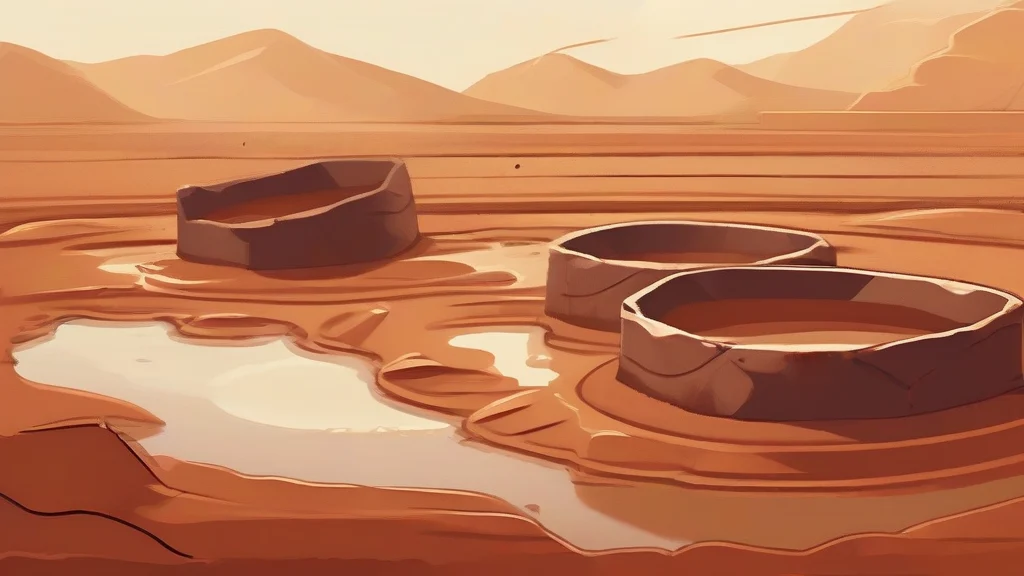
What does claypan mean?
A claypan is a hard, dense layer of clay found beneath the surface of the soil, distinguished by its near-impermeability to water and plant roots. Unlike ordinary subsoil, a claypan has been compacted into a barrier that slows or prevents the downward movement of rainwater, causing waterlogging above it and drought stress below it. The term appears most often in agricultural, geological, and soil-science contexts, particularly in regions with heavy clay soils such as parts of Australia, Britain, and the American Midwest. Farmers regard claypans as obstacles: they may use deep tillage techniques like subsoiling or "ripping" to fracture the layer and restore drainage. Closely related is the broader term hardpan, which covers hardened layers cemented by minerals of any kind, while claypan refers specifically to layers dominated by clay. Understanding the word is useful for anyone reading about land management, soil degradation, or the hidden structure of farmed landscapes.
nounA hard, dense, and relatively impermeable layer or deposit of clay in the subsoil, which restricts the drainage of water through the ground.
- A dense, compacted layer of clay beneath the soil surface that is largely impermeable to water and roots.
"The wheat struggled because a shallow claypan prevented rainwater from reaching the roots."
"After heavy rain, water pooled on the field for days because a claypan just below the surface blocked drainage."
"Deep ripping was used to fracture the claypan so that crops could send their roots deeper into the soil."
Standard English plural; used when referring to multiple such soil layers across a region or landscape.
"Claypans underlie much of the region's farmland, complicating irrigation planning."
Farmers have battled claypans for centuries — an invisible underground barrier so dense that even tree roots and rainfall cannot break through it.
Reviewed by Deb Chak, Editor. AI-assisted content curated by RJS Tech Solutions LLP.
Etymology of claypan
Claypan is a compound of two native English elements. "Clay" derives from Old English "clǣg," meaning sticky earth, ultimately from Proto-Germanic roots shared with German "Klei." "Pan" comes from Old English "panna," denoting a broad, shallow vessel, and by extension anything resembling one in shape or hardness. The compound arose as a descriptive term for flat, pan-like layers of dense clay in the subsoil, becoming established in agricultural and geological vocabulary, especially in Australia and North America, during the nineteenth century.
How claypan is actually used
"Claypan" belongs chiefly to agricultural, geological, and soil-science registers rather than everyday speech. It often carries a mildly negative connotation among farmers, since it impedes drainage and root growth. The term is common in Australia, the United States, and Britain wherever clay soils are farmed.
Easily confused with claypan
Hardpan is any hardened, impervious soil layer (often cemented by minerals such as iron or calcium), whereas claypan specifically refers to such a layer formed from compacted dense clay.