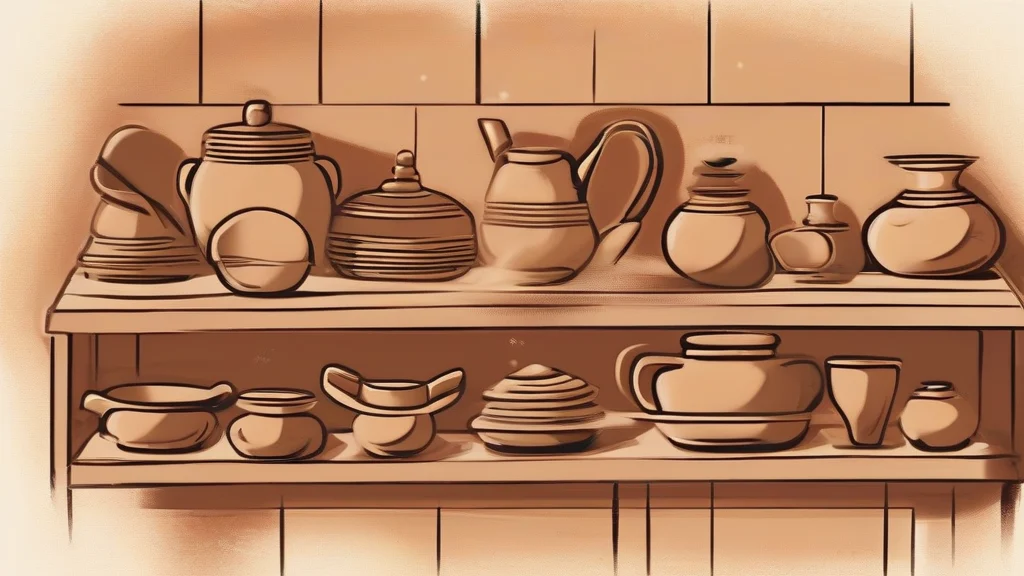
What does clayware mean?
Clayware is a collective noun for objects made from clay that have been shaped while wet and then hardened by firing at high temperature in a kiln. The category embraces a wide range of everyday items — pots, bowls, jugs, tiles, figurines, and drainage pipes — and is generally distinguished from porcelain, which is fired at higher temperatures from finer clays. In practice, the term appears most often in specialized contexts: archaeologists use it to describe excavated pottery fragments, manufacturers use it to classify product lines, and retailers use it to group unglazed or utilitarian ceramic goods. Its connotations are practical rather than artistic; where "pottery" can suggest craft and creativity, "clayware" tends to signal material category and function. Related terms include earthenware (a porous, lower-fired form) and stoneware (a denser, vitrified form), both of which fall under the broader umbrella of clayware. For readers encountering it on museum labels, trade catalogs, or archaeological reports, understanding "clayware" means recognizing a neutral, technical word for humanity's oldest manufactured material: fired earth.
nounClayware refers to objects, especially pottery and vessels, that are made from clay and hardened by firing in a kiln; it is often used as a collective term for ceramic goods as distinct from porcelain or stoneware.
- Objects made of clay that have been shaped and hardened by firing, considered collectively — especially everyday pottery such as pots, bowls, and tiles.
"The archaeologist carefully catalogued each shard of ancient clayware unearthed at the dig site."
"The museum's collection of Roman clayware includes lamps, jugs, and cooking vessels recovered from sites across Britain."
"Local artisans fire their hand-built clayware in a traditional wood-burning kiln over several days."
As a collective mass noun, "clayware" usually takes no plural; when a plural is needed to refer to distinct types or individual pieces, "claywares" is used.
"The shop sells claywares ranging from garden planters to dinner plates."
Every piece of clayware you've ever touched — from a flower pot to an ancient amphora — shares the same recipe: humble earth, water, and fire.
Reviewed by Deb Chak, Editor. AI-assisted content curated by RJS Tech Solutions LLP.
Etymology of clayware
Clayware is a straightforward English compound formed from "clay," the Old English word for the sticky earth used by potters (itself from Proto-Germanic roots), combined with the common suffix "-ware," which denotes manufactured goods and appears in words like hardware, software, and earthenware. The compound arose naturally within English, likely in trade or industrial usage, rather than being borrowed from another language. Its components connect it to the broader family of Germanic vocabulary for materials and goods.
How clayware is actually used
"Clayware" is a somewhat technical or trade-oriented term, more common in archaeology, ceramics manufacture, and retail contexts than in everyday speech, where "pottery" or "earthenware" are the usual words.
Easily confused with clayware
Stoneware is a specific dense, vitrified type of fired clay body, whereas clayware is the broader collective term covering all fired clay objects including earthenware.
A claymore is a type of large Scottish two-handed sword (or an anti-personnel mine), entirely unrelated to clay-based objects.