
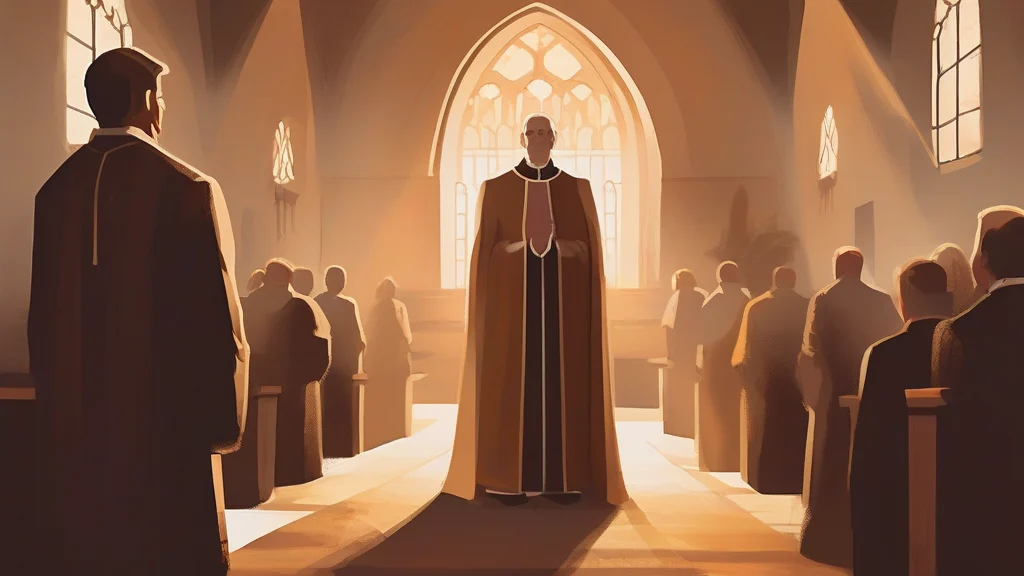
What does clergy mean?
Clergy refers to the body of men and women formally ordained to perform religious duties within a church or other faith community — priests, ministers, rabbis, imams, and their equivalents — set apart from ordinary worshippers, who are known as the laity. The word is almost always used collectively: one speaks of 'the clergy' as a group rather than of individual clergies. Although it looks plural, it can take either a singular or a plural verb, so both 'the clergy is divided' and 'the clergy are divided' are acceptable. In everyday usage the term appears frequently in discussions of religion's public role, from pastoral care to social commentary, and carries a formal, respectful tone. Its history is telling: clergy shares its origin with 'clerk', because in medieval Europe literacy was largely confined to those in holy orders.
nounThe body of people ordained for religious duties and offices in a church or other religious institution, especially as distinct from the laity.
- The collective body of ordained religious officials of a church or faith, as opposed to the laity.
"The local clergy gathered to console families after the flood."
"The cathedral's clergy processed into the nave behind the bishop."
"She was raised by parents who were both members of the clergy."
Clergy is a collective noun with no separate plural form; it already denotes a group. It may take singular or plural verb agreement, with plural agreement more common in British English.
"The clergy have been invited to lead the memorial service."
'Clergy' and 'clerk' are siblings: in medieval Europe, only clerics were usually literate, so 'clerk' simply meant a learned man.
Reviewed by Deb Chak, Editor. AI-assisted content curated by RJS Tech Solutions LLP.
Etymology of clergy
Clergy comes from Old French 'clergie', meaning the office or dignity of a cleric, derived from Late Latin 'clericus', itself borrowed from Greek 'klērikos', 'of the clergy'. The Greek term stems from 'klēros', meaning 'lot' or 'inheritance', alluding to the idea that ministers were the Lord's allotted portion. It entered Middle English around the thirteenth century and has cognates including 'clerk' and 'cleric'.
Related word forms
How clergy is actually used
Formal register. Though plural in form, 'clergy' is treated as either singular or plural ('the clergy is' or 'the clergy are'), with British English favoring the plural. Individual members are referred to as 'a member of the clergy', 'clergyman/clergywoman', or 'cleric'.
Easily confused with clergy
A clerk is an office worker or record-keeper; 'clergy' denotes ordained religious ministers, though both descend from the same Latin root 'clericus'.