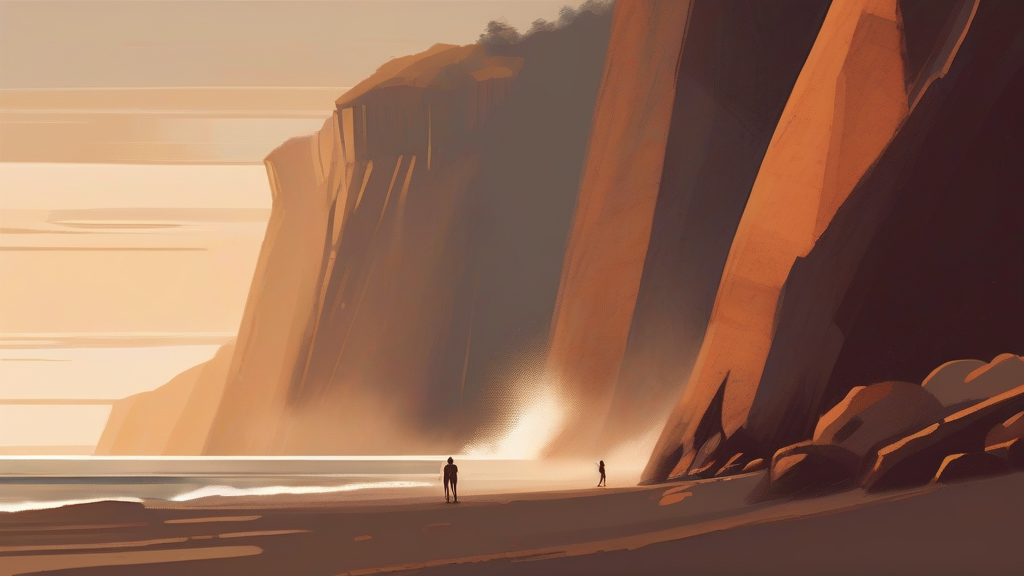
What does cliff mean?
A cliff is a steep, high face of rock, most commonly found along coastlines, rivers, or mountainous terrain, where erosion has carved away the softer material beneath harder stone. The word carries a strong sense of drama and danger: cliffs are natural vantage points but also hazards, which is why English frequently reaches for the word figuratively. Phrases like 'standing at the edge of a cliff' or the political term 'fiscal cliff' evoke a moment of imminent, irreversible change. In everyday speech, cliffs are associated with dramatic scenery — think of the White Cliffs of Dover or the sea cliffs of Ireland — making the word a staple of travel writing, geography, and literature alike. Related forms include cliffhanger, originally describing a melodramatic plot device left unresolved until the next installment, and cliffside, referring to the area adjoining a cliff. Whether describing literal rock formations or metaphorical brinkmanship, cliff remains a vivid, evocative term in modern English.
nounA steep, high rock face, especially one at the edge of the sea or of a river, rising sharply from the land or water below.
- A steep, high rock face, especially beside the sea.
- Figuratively, a critical turning point or point of no return, as in 'fiscal cliff' or 'the edge of a cliff' metaphorically.
"They stood at the edge of the cliff, watching the waves crash far below."
"The lighthouse perched precariously on the windswept cliff above the Atlantic."
"Analysts warned that failing to reach an agreement would push the economy off the fiscal cliff."
Regular plural; the final -ff simplifies to -fs in writing, and the pronunciation ends in /s/ rather than /z/.
"The coastline is famous for its towering limestone cliffs."
The White Cliffs of Dover are so tied to Britain's identity that during WWII, the phrase 'there'll be bluebirds over the white cliffs of Dover' became an anthem of hope.
Reviewed by Deb Chak, Editor. AI-assisted content curated by RJS Tech Solutions LLP.
Etymology of cliff
The word 'cliff' comes from the Old English 'clif', meaning a steep rock face, and belongs to a family of Germanic terms found across related languages: Dutch 'klif', German 'Klippe', and Swedish 'klippa'. It has been part of English since its earliest recorded stages, reflecting the prominent role of coastal and riverine rock formations in the landscapes of northern Europe. The word has remained remarkably stable in form and meaning throughout the history of English.
Related word forms
How cliff is actually used
Most often used literally in physical and geographic contexts; figurative uses such as 'fiscal cliff' are well-established in journalism. The plural is regular (cliffs), pronounced with a /s/ sound.
Easily confused with cliff
A 'cleft' is a split or division in rock or another surface, while a 'cliff' is a high, steep rock face.