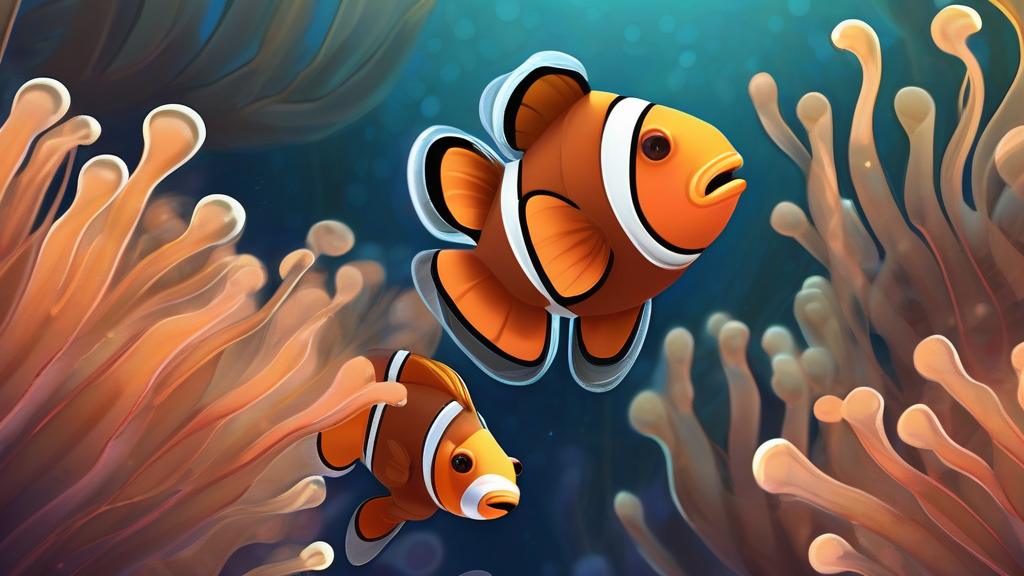
What does clownfish mean?
A clownfish is a small, vividly colored marine fish belonging to the subfamily Amphiprioninae, found in warm waters of the Indian and Pacific Oceans, including the Great Barrier Reef and the Red Sea. Typically bright orange with distinctive white bands outlined in black, clownfish are best known for their remarkable relationship with sea anemones: they live unharmed among the anemone's venomous tentacles, gaining protection from predators while helping to defend and clean their host in return — a classic example of mutualistic symbiosis. The name reflects the fish's playful, brightly patterned appearance, suggesting a painted face like that of a circus clown. Clownfish are protandrous hermaphrodites, meaning they are all born male and the dominant individual can change sex to become female. Popularized globally by the film Finding Nemo, the word is now familiar far beyond marine biology, and the species is a staple of public aquaria.
nounA small, brightly colored marine fish of the subfamily Amphiprioninae, typically orange with white bands, that lives among the stinging tentacles of sea anemones in tropical waters.
- A small orange-and-white marine fish of the subfamily Amphiprioninae that lives symbiotically with sea anemones.
"A pair of clownfish darted among the anemone's swaying tentacles."
"The clownfish sheltered within its host anemone, immune to the stinging cells."
"Children crowded around the aquarium tank to watch the clownfish."
Like many fish names, 'clownfish' often takes an uninflected plural, though 'clownfishes' is also standard.
"Several clownfish hovered near the coral outcrop."
Every clownfish is born male — the dominant individual in each group can transform into a female when needed.
Reviewed by Deb Chak, Editor. AI-assisted content curated by RJS Tech Solutions LLP.
Etymology of clownfish
The word 'clownfish' is a straightforward English compound formed from 'clown' plus 'fish', coined for the fish's gaudy, face-paint-like markings reminiscent of a circus clown's costume. The element 'clown' itself derives from Scandinavian sources — compare Old Norse 'klunni' and Icelandic 'klunnr', both meaning a clumsy fellow or blockhead — entering English around the sixteenth century. A closely related common name, 'anemonefish', refers to the same fishes and emphasizes their anemone association rather than their appearance.
How clownfish is actually used
Usually used as a count noun; the plural is commonly either 'clownfish' or 'clownfishes', with the uninflected plural more frequent. The term gained widespread popular recognition after the 2003 animated film Finding Nemo, whose protagonist is a clownfish.
Easily confused with clownfish
Clownfish are a specialized group within the damselfish family (Pomacentridae), but 'damselfish' refers broadly to the whole family, most of which are not anemone-dwelling.