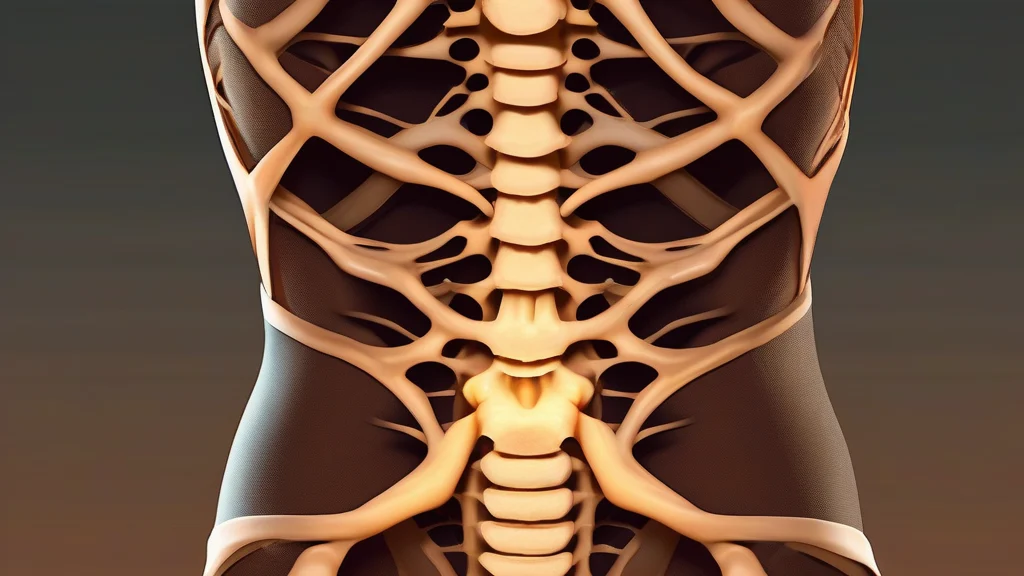
What does coccyx mean?
The coccyx is the small, roughly triangular bone that forms the lowest segment of the human vertebral column, sitting at the very bottom of the spine beneath the sacrum. Often informally called the tailbone, it results from the fusion of three to five rudimentary vertebrae — vestiges of a tail lost over evolutionary time — and serves as an anchor for pelvic muscles, ligaments, and tendons. Though tiny and largely vestigial, the coccyx matters in practice: injuries such as fractures or bruises, often caused by falls onto hard surfaces or childbirth, can produce persistent discomfort known as coccydynia. The word is primarily used in anatomy and medicine rather than casual conversation, where people are far likelier to say 'tailbone'. Its name has a charming origin: Greek anatomists saw its shape as resembling a cuckoo's beak and borrowed their word for the bird, kokkyx, to name it.
nounThe small triangular bone at the base of the spinal column in humans, formed by the fusion of three to five rudimentary vertebrae; commonly called the tailbone.
- The small terminal bone at the base of the human spine, formed by fused rudimentary vertebrae and serving as an attachment point for muscles and ligaments.
"She fractured her coccyx after slipping on the icy pavement."
"Falling backward onto hard ground is one of the most common ways to bruise the coccyx."
"The surgeon noted that the patient's coccyx curved forward more than usual."
In formal medical and anatomical writing the plural follows the Greek/Latin form 'coccyges'; the anglicized plural 'coccyxes' is also accepted.
"Radiographs of both coccyges revealed similar curvature in the twins."
Your tailbone is named after a bird: ancient Greek anatomists thought it looked like a cuckoo's beak, so they called it the 'kokkyx' — literally, the cuckoo.
Reviewed by Deb Chak, Editor. AI-assisted content curated by RJS Tech Solutions LLP.
Etymology of coccyx
The word 'coccyx' comes via New Latin from Greek 'kokkyx', meaning both 'cuckoo' and this bone, which early anatomists likened to the curved beak of a cuckoo. It entered English medical vocabulary in the early modern period through Latin anatomical texts, alongside related forms such as the adjective 'coccygeal'. Its only familiar English relative sharing the same Greek root is the word 'cuckoo' itself.
Related word forms
How coccyx is actually used
A chiefly anatomical and medical term, rare in everyday speech outside discussions of injury or back pain, where the informal synonym 'tailbone' is more common. The plural 'coccyges' (pronounced /ˈkɒk.sɪ.dʒiːz/) is used in formal medical writing, though 'coccyxes' also appears.
Easily confused with coccyx
The sacrum is the larger triangular bone above the coccyx formed by five fused vertebrae, whereas the coccyx is the smaller terminal bone at the very bottom of the spine.