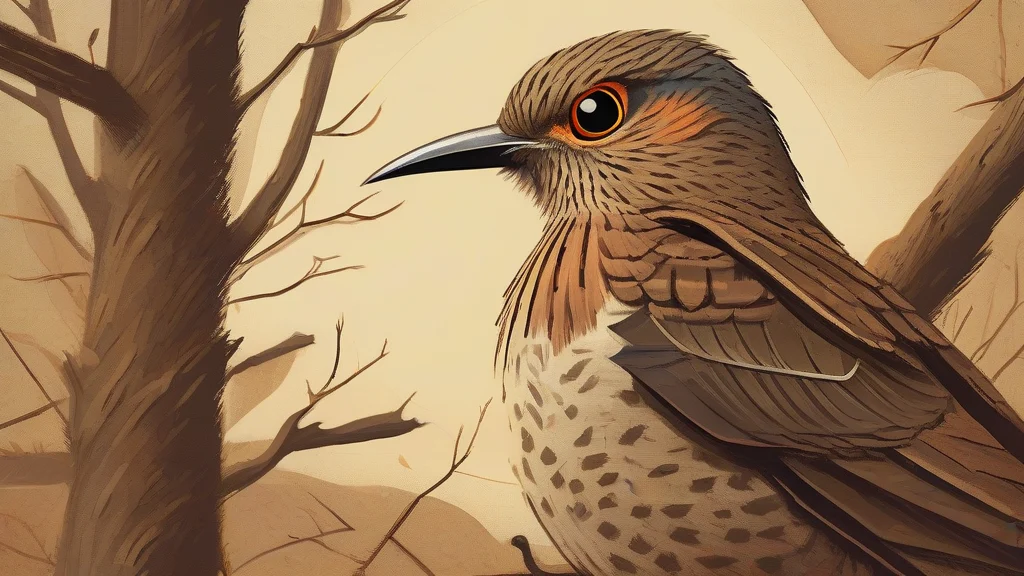
What does cuckoo mean?
A cuckoo is a bird belonging to the family Cuculidae, found across much of the world, though the best-known species — the common cuckoo of Europe and Asia — has become famous for one remarkable behavior: brood parasitism. Rather than raising its own young, the female lays her eggs in the nests of other birds such as reed warblers or meadow pipits, leaving the unsuspecting hosts to incubate the egg and feed the chick, which often pushes their own offspring out of the nest. The male's clear, two-note call, sounding like the word itself, is a traditional herald of spring in Europe and has inspired countless poems, folk songs, and clocks. Beyond ornithology, 'cuckoo' also serves as a mild, somewhat old-fashioned insult for someone foolish or slightly mad — a usage rooted in the same idea of being duped. Whether describing a bird, a clock, or a character, the word carries connotations of deception, springtime, and gentle absurdity.
A medium-sized bird of the family Cuculidae, noted for its distinctive two-note call and, in many species, the habit of laying eggs in other birds' nests.
"Every April, the first cuckoo of spring could be heard calling from the birch woods."
In British culture, hearing the first cuckoo of the year is traditionally associated with the arrival of spring.
(Informal) A foolish, eccentric, or mentally unsound person.
"Only a cuckoo would try to swim across that river in February."
This sense is chiefly informal American English and can sound dated; it carries mild humor rather than strong offense.
Standard plural; no irregular form exists.
"Cuckoos migrate from Africa to Europe each spring."
The cuckoo lays its eggs in other birds' nests, letting unwitting foster parents raise its chicks — and it even evicts the host's own eggs to make room.
Reviewed by Deb Chak, Editor. AI-assisted content curated by RJS Tech Solutions LLP.
Etymology of cuckoo
The word 'cuckoo' comes from Old French 'cocu', which itself imitates the bird's distinctive two-note call — making it an onomatopoeic word. It entered Middle English around the 13th century, appearing in medieval songs and poetry. The related word 'cuckold' arose from the same root, since the bird was seen as deceiving other birds into caring for its offspring, just as a cuckolded husband is deceived by an unfaithful wife. Cognates appear across Romance languages, including Spanish 'cuclillo' and Italian 'cuccù'.
Related word forms
How cuckoo is actually used
As an informal insult, 'cuckoo' is mildly humorous rather than harsh, suggesting eccentricity or silliness more than malice; it appears mostly in casual speech and older American usage. The bird sense is standard worldwide.
Easily confused with cuckoo
The correct spelling is 'cuckold' — a man whose wife is unfaithful — derived from 'cuckoo', reflecting the bird's brood-parasitism habit.