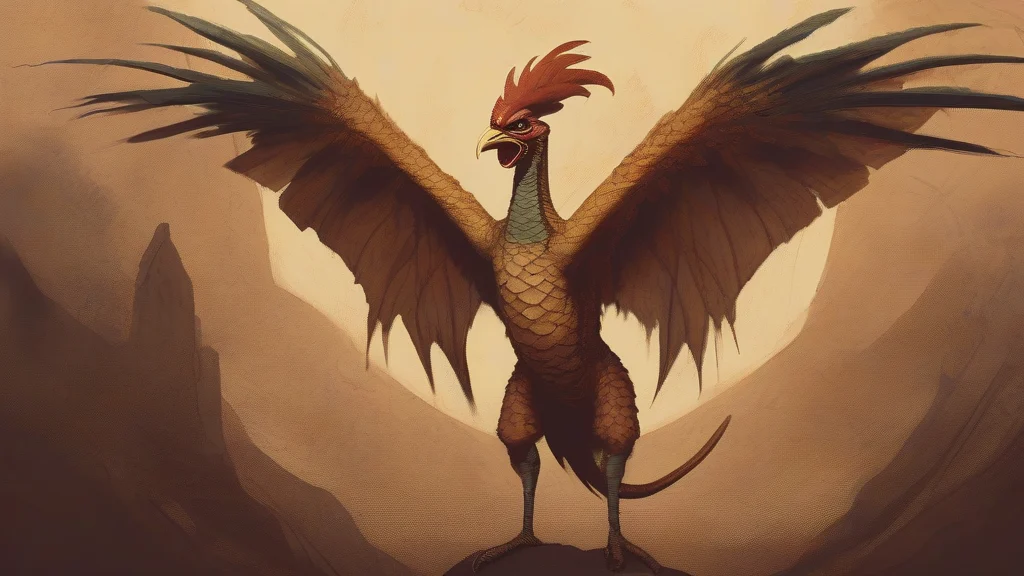
What does cockatrice mean?
A cockatrice is a fabulous creature of medieval European legend, usually imagined as a serpent with the head, wings, and sometimes the legs of a rooster — a hybrid monster so venomous that its glance or breath was believed to strike victims dead. It belongs to the same family of deadly serpents as the basilisk, and the two were often conflated by medieval writers. The cockatrice featured prominently in bestiaries, heraldry, and early English literature, and it entered the English Bible through the King James translators, who used it for Hebrew terms for venomous serpents in Isaiah. Today the word survives chiefly in literary, historical, and heraldic contexts, where it evokes the gothic imagination of the Middle Ages rather than anything in the natural world. Its enduring appeal lies in its striking image: a monster hatched, legend claimed, from an egg laid by a cock and incubated by a serpent or toad.
A legendary monster of medieval European folklore, part serpent and part rooster, whose glance or breath was reputedly fatal.
"The knight's shield bore a cockatrice coiled beneath his crest."
Almost always found in historical, literary, mythological, or heraldic contexts; never used of real animals.
Figuratively and rarely, a deadly or treacherous person or thing.
"He described rumour as a cockatrice whose stare could ruin an honest name."
Chiefly literary and now very rare.
The standard plural simply adds -es; it follows normal English noun pluralization.
"Old bestiaries catalogued cockatrices alongside dragons and basilisks."
The cockatrice appears in the King James Bible — Isaiah 11:8 has a child playing safely at the den of the cockatrice, one of the most vivid monsters ever to slip into English scripture.
Reviewed by Deb Chak, Editor. AI-assisted content curated by RJS Tech Solutions LLP.
Etymology of cockatrice
The word comes from Old French 'cocatris', borrowed in late Middle English, ultimately from medieval Latin 'calcatrix', meaning 'treader' or 'tracker', derived from Latin 'calcare', 'to tread or trample'. The name reflects the belief that the creature stamped or trailed after its prey. The same Latin root gives English such unrelated-looking words as 'calculate' (from small counting pebbles) and 'chalk'. The spelling with '-trice' was influenced by association with other agent nouns ending in '-trix'.
How cockatrice is actually used
The word is almost exclusively literary, historical, or heraldic today; it carries an archaic, gothic flavour and appears mainly in discussions of mythology, bestiaries, biblical translation, and heraldry. It is not used colloquially.
Easily confused with cockatrice
The basilisk is a closely related but distinct legendary serpent, often depicted as crowned and born from a serpent's egg, whereas the cockatrice is specifically part rooster and part snake.
A cockatiel is a small real Australian parrot, entirely unrelated to the mythical cockatrice despite the similar spelling.