What does basilisk mean?
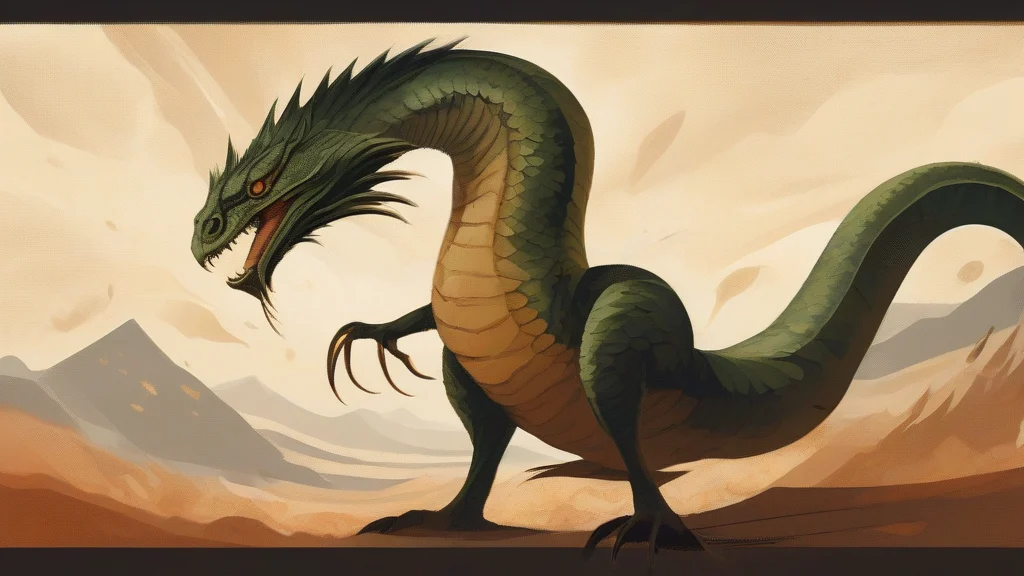
The basilisk is a creature of European legend: a serpent, variously described as crowned or crested, reputedly hatched from a cock's egg by a serpent and able to kill with a single glance or breath of venom. Medieval bestiaries ranked it as the king of serpents, and it became a stock figure of terror in literature, heraldry, and later works of fantasy, including modern fiction such as J.K. Rowling's Harry Potter series. The word has a second, entirely literal life in zoology, naming Basiliscus, a genus of large, agile lizards of Central and South American rainforests — most famously the plumed basilisk, which can scamper on its hind legs across the surface of water. Figuratively, 'a basilisk stare' or 'basilisk glare' describes an intensely hostile or petrifying look, giving English a vivid way to convey cold, lethal displeasure. Few words so neatly bridge myth, menace, and living nature.
A legendary serpent-like creature of European folklore, said to be born from a cock's egg and able to kill with a glance or breath.
"Legend held that even the knight's mirror-polished shield could not save him from the basilisk's deadly gaze."
Any of several large, crested, largely arboreal lizards of the genus Basiliscus, found in Central and South America, noted for their ability to run across water.
"We spotted a green basilisk skimming over the stream on its hind legs."
Standard regular plural; used for both the mythical creatures and the lizards.
"Medieval tapestries depicted basilisks coiled among the roots of the forest."
According to legend, the only way to slay a basilisk was to show it its own reflection — its fatal weapon turned against itself.
Reviewed by Deb Chak, Editor. AI-assisted content curated by RJS Tech Solutions LLP.
Etymology of basilisk
Basilisk derives from Greek basilískos, meaning 'little king', a diminutive of basileus ('king'), reflecting the creature's reputation as the king of serpents; the same Greek root gives English words like 'basilica' and the herb name 'basil'. The term passed into Latin as basiliscus and reached medieval Europe largely through Latin natural histories such as Pliny's account of the deadly serpent of Cyrene. It entered English via Old French during the Middle Ages, and the zoological application to the New World lizard followed once European naturalists classified the animal in the eighteenth century.
How basilisk is actually used
In modern English, 'basilisk' is used both literally (for the real Central American lizard) and figuratively or mythologically (for the deadly legendary serpent). The figurative sense often appears in fantasy literature and in descriptions of a withering stare ('a basilisk glare'), where it carries connotations of menace or cold hostility.
Easily confused with basilisk
The cockatrice is a closely related legendary beast (often a serpent with a cock's head) frequently conflated with the basilisk; in some traditions they are treated as variants of the same creature, but 'cockatrice' specifically denotes the cock-headed form.