
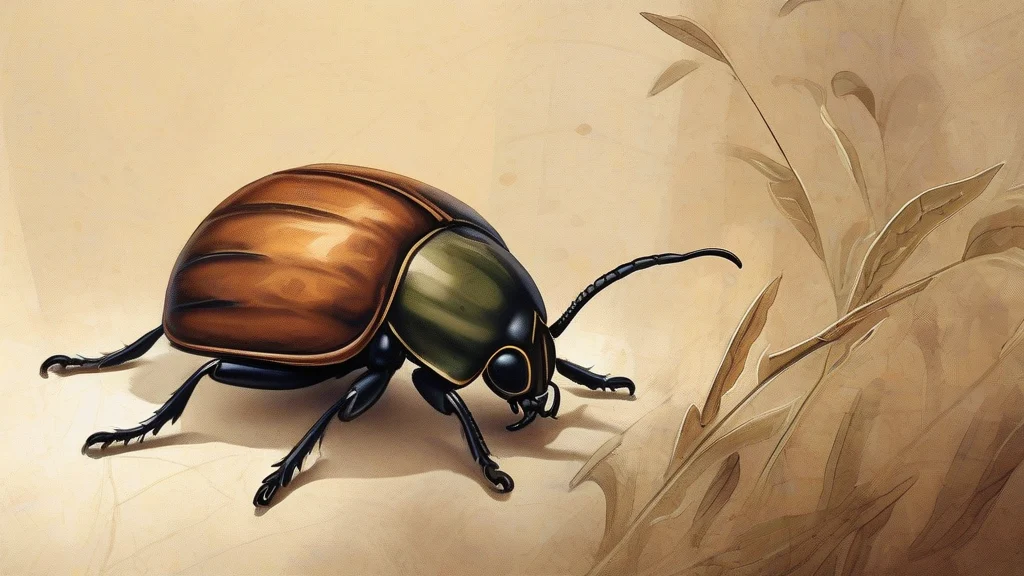
What does coleoptera mean?
Coleoptera is the scientific order name for beetles and weevils, the single largest order in the entire animal kingdom, encompassing more than 350,000 described species — by some counts a quarter of all known animal life. The name derives from the Greek for 'sheath-winged', reflecting the order's defining trait: a pair of hardened forewings called elytra that fold over the delicate hind wings like a protective case. Because the word functions as a formal taxonomic label, it appears almost exclusively in entomological literature, museum collections, and academic discussion rather than everyday conversation, where 'beetles' would serve instead. It is conventionally capitalized as a proper taxonomic category. For anyone interested in natural history, Coleoptera is worth knowing simply because its scale is staggering: from tiny ladybirds to enormous stag beetles, the diversity within this single order rivals that of most other groups combined.
nounThe largest order of insects, comprising the beetles and weevils, characterized by a pair of hardened forewings (elytra) that cover and protect the membranous hind wings.
- As the scientific name for the insect order comprising beetles and weevils.
"The field guide devoted an entire chapter to the coleoptera, so vast is that order of beetles."
"Entomologists estimate that the Coleoptera contains well over 350,000 described species, more than any other animal order."
"In her taxonomy lecture, she explained how the hardened elytra distinguish the Coleoptera from all other insect orders."
Coleoptera is already inherently plural, being the collective name for all beetles; the singular form is 'coleopteron'.
"Several specimens from different families of the Coleoptera were pinned in the display case."
Beetles are so successful that roughly one in every four known animal species on Earth is a member of Coleoptera — a naturalist could spend a lifetime cataloguing them and barely scratch the surface.
Reviewed by Deb Chak, Editor. AI-assisted content curated by RJS Tech Solutions LLP.
Etymology of coleoptera
Coleoptera comes from New Latin, itself borrowed from the Greek 'koleopteros', meaning 'sheath-winged' — from 'koleos' (a sheath) and 'pteron' (a wing), a reference to the beetle's hardened forewings. The term entered scientific usage in the early modern period as biologists began formally classifying insects into orders. The same Greek root 'pteron' recurs across entomology in names such as Lepidoptera (butterflies and moths) and Diptera (flies), making these terms recognizable cognates within taxonomy.
How coleoptera is actually used
A technical term used almost exclusively in entomology and scientific writing; it is always treated as plural (or occasionally as a collective singular) and conventionally capitalized when referring to the formal taxonomic order. In everyday speech one would simply say 'beetles'.
Easily confused with coleoptera
Coleoptera is the order of beetles with hardened forewings, while Lepidoptera is the entirely different order comprising butterflies and moths.