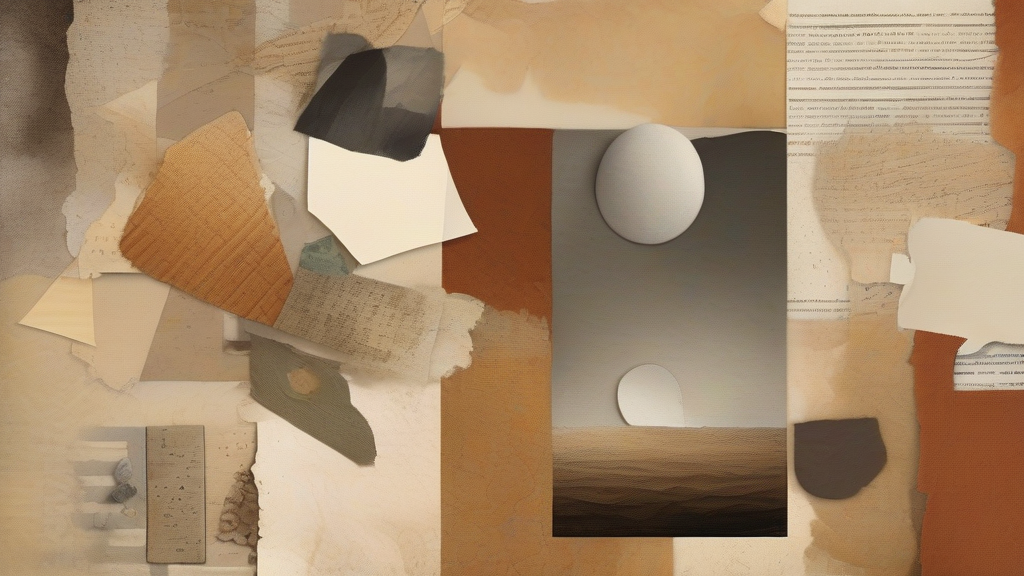
What does collage mean?
A collage is an artistic work created by attaching pieces of material — such as paper, photographs, fabric, or found objects — onto a flat surface, producing a unified image from fragmented parts. Emerging as a deliberate fine-art technique in early twentieth-century modernism, notably through the experiments of Pablo Picasso and Georges Braque, collage challenged traditional notions of painting by incorporating real-world materials directly into the picture plane. Beyond the art world, the word has broadened into a useful figurative term: journalists and writers describe 'a collage of sounds', 'a collage of memories', or 'a collage of cultures' to convey a rich, layered mixture of heterogeneous elements. This dual character makes 'collage' valuable both as a precise technical term in visual arts and as an evocative metaphor for anything assembled from diverse pieces into a coherent whole.
nounA work of art made by gluing pieces of paper, photographs, fabric, or other materials onto a flat surface; more generally, an assemblage or mixture of disparate elements.
- An artwork created by affixing pieces of paper, photographs, fabric, or other materials to a surface.
- By extension, any collection or combination of diverse elements perceived as a whole (e.g. 'a collage of sounds').
"She created a striking collage of newspaper clippings and torn photographs for the exhibition's centerpiece."
"Her portfolio included a collage assembled from vintage travel brochures and handwritten letters."
"The film's soundtrack is a collage of street noises, jazz snippets, and overlapping conversations."
Standard regular plural; used freely in both everyday and art-critical writing.
"The gallery's walls were hung with dozens of small collages from local schoolchildren."
The word 'collage' comes straight from the French for 'glueing' — so every collage is literally named after the paste that holds it together.
Reviewed by Deb Chak, Editor. AI-assisted content curated by RJS Tech Solutions LLP.
Etymology of collage
The word 'collage' derives from the French 'coller', meaning 'to glue' or 'to stick', which traces back through Old French to Latin 'glutinare', from 'gluten' (glue). It entered English in the early twentieth century, coinciding with the rise of papier collé and related techniques among Cubist painters such as Picasso and Braque. It shares this glue-root ancestry with English words like 'glue', 'gluten', and 'colloid'.
Related word forms
How collage is actually used
Collage is a neutral, standard term in both everyday and art-historical contexts. The extended figurative sense ('a collage of experiences') is common in journalism and literary writing. The plural 'collages' is standard.
Easily confused with collage
Colligate is a rare logic term meaning to bind or connect ideas together under a general concept, whereas collage is a visual artwork or assemblage made from pasted materials.
College is an institution of higher education, while collage is an artwork assembled from glued fragments — the two share only a similar sound.