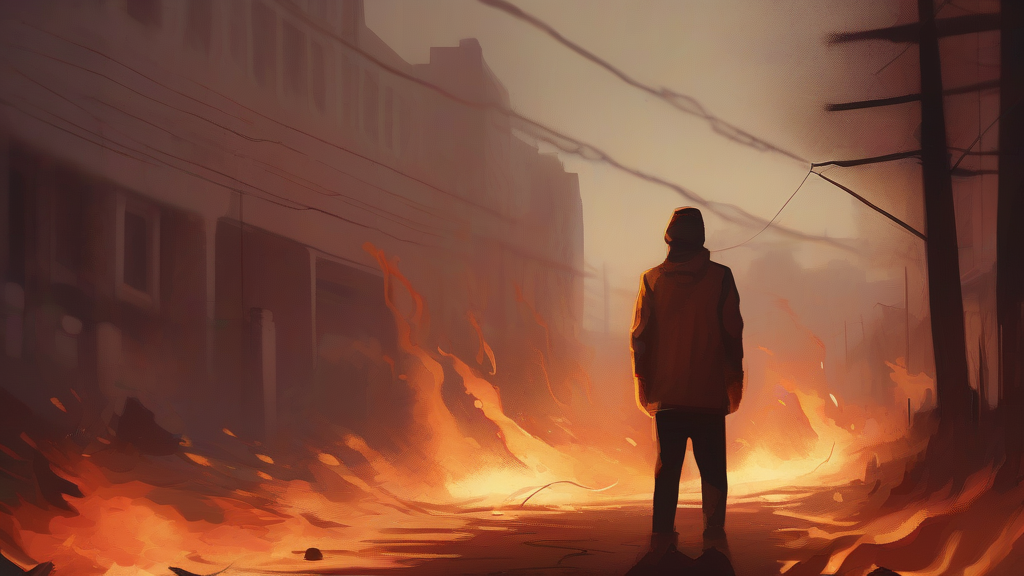
What does conflagration mean?
A conflagration is a large, destructive fire — the kind that engulfs whole buildings, forests, or districts rather than a small contained blaze. The word is formal and somewhat literary in register, chosen when a writer wants to convey not just heat and flames but scale, violence, and devastation. It is also used figuratively to describe wars, riots, or political crises that spread rapidly and draw many people into their orbit, much like a fire spreading through dry tinder: journalists might speak of a regional conflagration threatening to engulf neighbouring states. Derived from the Latin verb 'flagrare', meaning to burn, it entered English in the early seventeenth century and has long been associated with history's great urban fires. For anyone writing about disaster, war, or upheaval, 'conflagration' offers a precise and vivid term that signals both magnitude and gravity.
A large, destructive fire that spreads rapidly over a wide area.
"The conflagration left thousands homeless across the city."
Often used for historically significant fires, e.g. the Great Conflagration of 1871 (Chicago).
(Figurative) A violent conflict or upheaval affecting many people.
"Diplomats feared the dispute would escalate into a wider conflagration."
Common in political journalism and historical writing.
Standard regular plural. Often used when discussing multiple historic fires or recurring conflicts.
"History records several great urban conflagrations, from Rome to London to Chicago."
The word 'conflagration' comes from the same Latin root as 'flame' — and the Great Fire of London was long called simply 'the Great Conflagration'.
Reviewed by Deb Chak, Editor. AI-assisted content curated by RJS Tech Solutions LLP.
Etymology of conflagration
'Conflagration' derives from the Latin verb 'flagrare', meaning to burn or blaze, combined with the intensive prefix 'con-'; the noun 'conflagratio' meant a burning up. It entered English in the early seventeenth century via Latin, joining a family of English words from the same root including 'flame', 'flammable', and 'flagrant'. Its earliest uses referred to great destructive fires, and the figurative sense — a sweeping conflict or crisis — developed later.
How conflagration is actually used
Formal register. In modern usage 'conflagration' carries a literary or elevated tone — it suggests scale and destructiveness beyond an ordinary fire. The figurative sense (war, unrest) is well established but less common than the literal one.
Easily confused with conflagration
Inflammation refers to a biological swelling or irritation of tissue, whereas conflagration is a large destructive fire (or figurative upheaval).
Deflagration is a rapid combustion that moves through a substance at subsonic speed (as in explosives), while conflagration denotes a widespread, uncontrolled blaze.