What does conga mean?
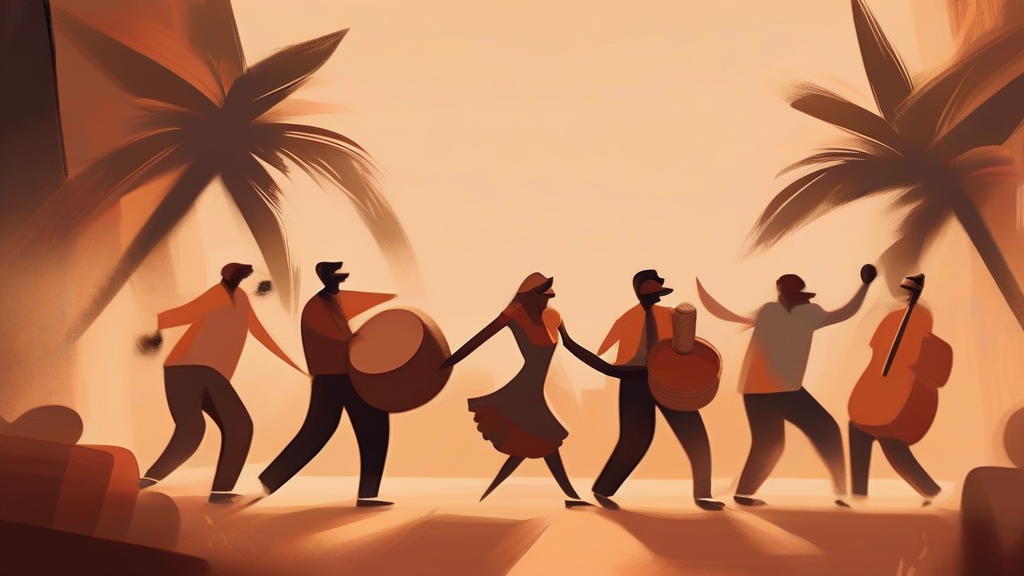
The conga is a lively Afro-Cuban dance in which participants form a single-file line, holding the hips or shoulders of the person in front while performing a shuffling three-step movement accented by an occasional kick. Led by a dancer who steers the line in a winding path through the room, it has become a universal symbol of celebration, appearing everywhere from Caribbean carnivals to weddings and cruise ships. The word also denotes the tall, hand-played drum — usually played in pairs — whose insistent rhythm drives the dance, and it functions as a verb meaning to perform the dance itself. Borrowed from Cuban Spanish in the early twentieth century, when the dance swept through North America and Europe, the conga retains festive, communal connotations: to conga is to abandon self-consciousness and join the party. Its name is commonly traced to African roots via the Kongo region.
A Cuban ballroom dance performed in a single-file line with a three-step-plus-kick pattern.
"The band struck up a conga and half the room fell into line."
In the plural, 'congas' typically means the drums rather than instances of the dance.
A tall, narrow, single-headed Latin American hand drum, usually played in pairs.
"He set up his congas beside the timbales before the gig."
To dance the conga, especially as part of a winding line of dancers.
"Everyone congaed out onto the terrace at the end of the night."
Informal register, almost always in celebratory contexts.
The standard plural. Note that 'the congas' most often refers to the paired drums; for multiple instances of the dance, phrases like 'several congas' are rare and contexts favor 'rounds of the conga'.
"Two congas and a pair of bongos sat at the centre of the stage."
The conga turns strangers into a single wriggling party animal — one leader, one rhythm, everyone else just holds on and kicks.
Reviewed by Deb Chak, Editor. AI-assisted content curated by RJS Tech Solutions LLP.
Etymology of conga
The word 'conga' entered English from Cuban Spanish, where it named both the dance and the drum, spreading internationally during the dance craze of the 1930s. Its ultimate origin is generally traced to Africa, being widely connected to Kongo — the region and people of Central Africa — reflecting the African heritage of much Cuban music. Related Latin dance terms such as rumba and mambo followed similar paths from the Spanish-speaking Caribbean into English.
How conga is actually used
The plural 'congas' usually refers to the pair of drums played together rather than multiple dances. As a verb, it is informal and festive in register, most often heard in party contexts ('everyone congaed into the marquee'). The word carries uniformly joyful, celebratory connotations.
Easily confused with conga
'Conga' names a Cuban line dance and its drum, whereas 'Congo' refers to the river and countries in Central Africa — though the dance's name is often linked to African origins.